
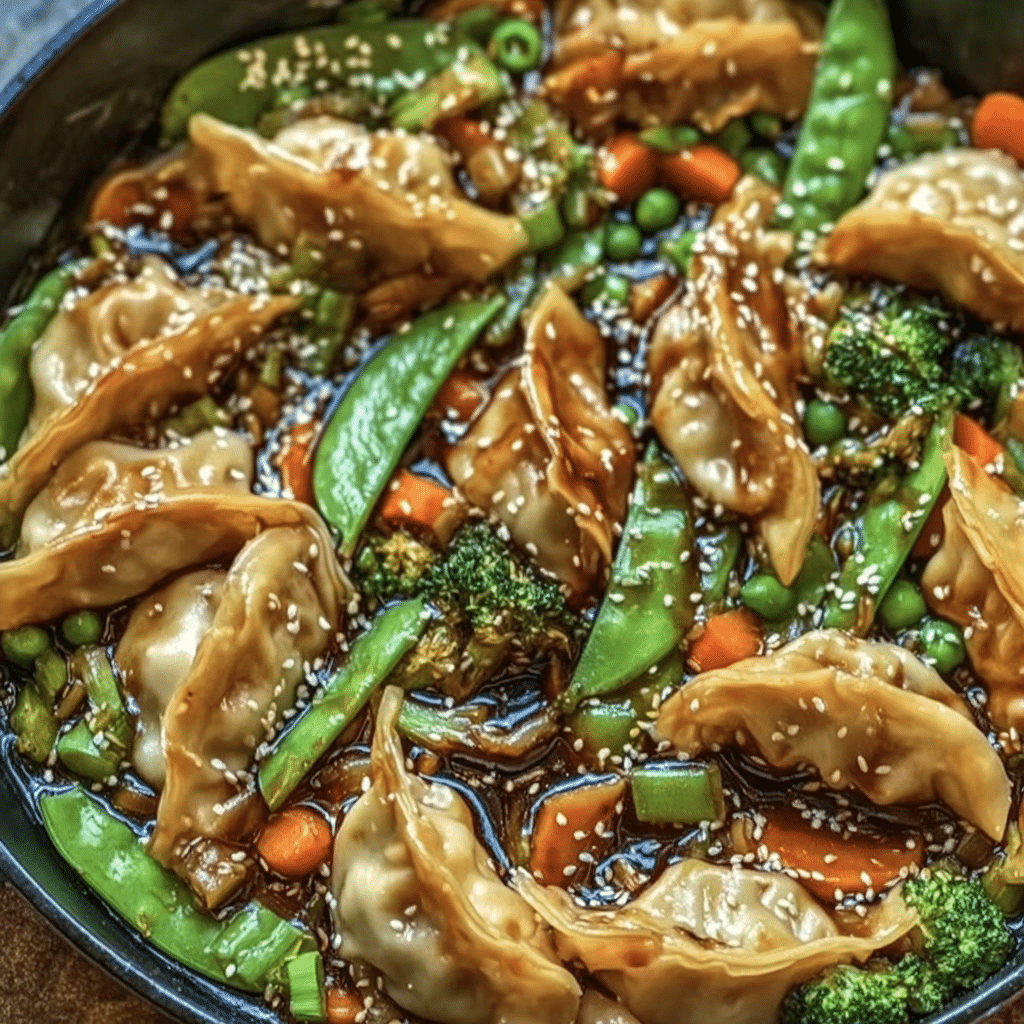
Introduction: The Best of Both Worlds in One Sizzling Skillet
There is a beautiful tension at the heart of every great potsticker. One side is golden and crispy, shattering satisfyingly between your teeth. The other is tender and chewy, yielding to the juicy filling within. Now, imagine taking that perfect dumpling and tossing it into a wok-hot skillet with crisp-tender vegetables, a glossy, savory-sweet Asian-inspired sauce, and the aromatic punch of fresh garlic and ginger. The result is the Crispy Potsticker Skillet Stir Fry—a dish that transforms a beloved appetizer into a complete, crowd-pleasing meal.
This recipe is a revelation for anyone who loves potstickers but wishes they could be the centerpiece of a dinner rather than a prelude to one. By pan-frying the potstickers first to achieve that signature crispy bottom, then steaming them to tender perfection, and finally tossing them with vibrant vegetables and a homemade sauce, we create a dish that is greater than the sum of its parts. The potstickers retain their crispiness (even after being coated in sauce, a clever trick we will explain), the vegetables stay bright and crunchy, and the sauce ties everything together with its perfect balance of salty, sweet, tangy, and savory.
What makes this recipe so brilliant for home cooks is its efficiency. It comes together in a single skillet (plus a small bowl for the sauce), making cleanup a breeze. It uses frozen potstickers, which are widely available and require no advance preparation. The vegetables are flexible—use what you have or what looks good at the market. The sauce comes together in minutes from pantry staples. And the entire dish, from the first chop to the final garnish, takes less than 30 minutes.
This is the kind of meal that solves the weeknight dinner equation perfectly. It is fast enough for a Tuesday, impressive enough for guests, and healthy enough (look at all those vegetables!) to feel good about serving to your family. It is also endlessly adaptable: make it spicier with chili crisp, vegetarian with vegetable potstickers, or low-sodium with tamari and reduced-sodium sauces.
In this article, we will explore every nuance of the Crispy Potsticker Skillet Stir Fry. We will discuss the best ingredients, from choosing the right potstickers to understanding the role of cornstarch slurry. We will walk through a detailed, step-by-step method that ensures success, whether you are a stir-fry novice or a wok-wielding expert. Finally, we will answer the most frequently asked questions, offering substitutions, storage tips, and creative variations to make this recipe a permanent fixture in your dinner rotation.
Heat your skillet. It is time to stir-fry.
Ingredients: The Building Blocks of Crispy, Saucy Perfection
Before we fire up the stove, let us take a moment to understand each ingredient. This recipe has three main components: the potstickers, the vegetables, and the sauce. Every item on this list has a job, and understanding those jobs is the key to culinary success. Below is the complete list, followed by detailed notes on selection, quality, and potential substitutions.
For the Potstickers and Vegetables:
- 1 package frozen potstickers (about 20–24 pieces)
- 2 tablespoons vegetable oil, divided
- 1 red bell pepper, sliced
- 1 cup broccoli florets
- 1 carrot, julienned
- 3 green onions, chopped
- 2 cloves garlic, minced
- 1 teaspoon fresh ginger, grated
For the Sauce:
- ¼ cup soy sauce
- 2 tablespoons hoisin sauce
- 1 tablespoon rice vinegar
- 1 tablespoon sesame oil
- 1 teaspoon honey or sugar
- 1 teaspoon cornstarch + 2 tablespoons water (slurry)
Cook Mode Note: As you prepare this recipe, you may want to prevent your screen from going dark. Most devices offer a “stay awake” or “cook mode” setting in their display options, allowing you to reference the instructions without constantly tapping the screen.
Ingredient Deep Dive
1. Frozen Potstickers (1 package, about 20–24 pieces)
Potstickers (also known as guotie in Chinese or yaki-gyoza in Japanese) are dumplings filled with a mixture of ground meat (typically pork, chicken, or shrimp) and finely chopped vegetables (cabbage, scallions, ginger). The frozen variety is a brilliant convenience product—they are already shaped, filled, and partially cooked, requiring only browning and steaming to become restaurant-quality. Look for potstickers with a good balance of filling to wrapper, and avoid any packages that show signs of freezer burn (ice crystals, discoloration). Pork potstickers are most traditional, but chicken, shrimp, or vegetable potstickers all work beautifully. One package typically contains 20–24 pieces, which is perfect for 2–3 servings as a main dish or 4 servings as part of a larger meal.
2. Vegetable Oil (2 tablespoons, divided)
Vegetable oil has a high smoke point and neutral flavor, making it ideal for both pan-frying the potstickers and stir-frying the vegetables. The oil is divided: 1 tablespoon for the potstickers, 1 tablespoon for the vegetables. You can substitute canola oil, avocado oil, or grapeseed oil. Avoid olive oil for this recipe; its smoke point is lower and its flavor can compete with the Asian-inspired sauce.
3. Red Bell Pepper (1, sliced)
Red bell pepper adds sweetness, color, and crunch. Its vibrant red hue contrasts beautifully with the green broccoli and orange carrot. Slice the pepper into thin strips (about ¼ inch wide and 2 inches long) so they cook quickly and evenly. Yellow or orange bell peppers can substitute; green bell peppers are slightly more bitter but also work.
4. Broccoli Florets (1 cup)
Broccoli adds color, nutrition, and a satisfying, earthy crunch. Cut the florets into bite-sized pieces (about 1–1.5 inches). The stems are also edible; peel the tough outer layer and slice thinly to add to the stir-fry. One cup of florets is approximately half of a medium head of broccoli.
5. Carrot (1, julienned)
Julienned carrot adds sweetness, color, and a delicate crunch. “Julienned” means cut into thin, matchstick-sized strips (about 2 inches long and ⅛ inch thick). A julienne peeler makes this task easy, or you can use a sharp knife to slice the carrot thinly and then stack the slices to cut into matchsticks. Pre-shredded carrot (from a bag) can substitute, though the texture will be slightly different.
6. Green Onions (3, chopped)
Green onions (also called scallions) provide a mild, fresh onion flavor and a pop of green color. Both the white and green parts are usable; the white part is more pungent, the green part milder and more decorative. Chop them into ¼-inch pieces. Reserve a small amount of the dark green tops for garnish.
7. Garlic (2 cloves, minced)
Fresh garlic is essential for authentic stir-fry flavor. Two cloves, minced finely, will infuse the oil with their aromatic, pungent goodness. Mince the garlic finely so it distributes evenly and cooks quickly without burning. Do not use jarred pre-minced garlic; it has a flat, bitter taste and contains preservatives.
8. Fresh Ginger (1 teaspoon, grated)
Fresh ginger is the aromatic partner to garlic, adding warmth, brightness, and a slight peppery zing. Grating the ginger (rather than chopping) releases more of its juice and ensures it melts into the sauce. Use a microplane or the fine side of a box grater. Do not substitute dried ground ginger, which has a different flavor profile and can be bitter.
9. Soy Sauce (¼ cup)
Soy sauce is the salty, umami backbone of the sauce. It provides depth and saltiness that ties all the other flavors together. Use regular (all-purpose) soy sauce or light soy sauce. For a lower-sodium version, use reduced-sodium soy sauce. For a gluten-free version, use tamari or coconut aminos (note that coconut aminos are sweeter, so reduce the honey slightly).
10. Hoisin Sauce (2 tablespoons)
Hoisin sauce is a thick, fragrant, sweet-and-savory Chinese sauce made from soybeans, garlic, chili, sugar, and various spices. It adds complexity, sweetness, and a deep reddish-brown color to the sauce. It is often described as “Chinese barbecue sauce.” If you do not have hoisin, you can substitute a mixture of 1 tablespoon soy sauce, 1 tablespoon black bean paste, and 1 teaspoon sugar, or use oyster sauce (though oyster sauce is less sweet and more savory).
11. Rice Vinegar (1 tablespoon)
Rice vinegar is mild, slightly sweet, and less acidic than Western white vinegar. It adds brightness and tang that balances the richness of the hoisin and sesame oil. Do not substitute white vinegar or apple cider vinegar, which are more acidic and have different flavor profiles. Unseasoned rice vinegar is preferred; seasoned rice vinegar contains added sugar and salt.
12. Sesame Oil (1 tablespoon)
Sesame oil is a fragrant, nutty oil made from toasted sesame seeds. It is used as a finishing oil rather than a cooking oil (its smoke point is low). A small amount adds a distinctive, aromatic flavor that is essential to many Asian dishes. Use toasted sesame oil (dark brown) rather than untoasted sesame oil (pale yellow), which lacks the characteristic nutty flavor.
13. Honey or Sugar (1 teaspoon)
A touch of sweetness balances the saltiness of the soy sauce and the tang of the vinegar. Honey adds a floral sweetness and helps the sauce coat the ingredients more smoothly. Granulated sugar or brown sugar can substitute. Use 1 teaspoon as a starting point; adjust to taste.
14. Cornstarch (1 teaspoon) + Water (2 tablespoons)
This mixture is called a “slurry.” Cornstarch is a powerful thickener; when mixed with cold water and added to a simmering liquid, it swells and creates a glossy, thickened sauce. The ratio of 1 teaspoon cornstarch to 2 tablespoons water is correct for this amount of sauce. Do not add the cornstarch directly to the hot sauce without first mixing it with cold water, or it will form lumps. For a gluten-free slurry, cornstarch is already gluten-free; arrowroot powder or potato starch can also be used.
Preparation Method: Step-by-Step to Crispy, Saucy Perfection
Now, we move from ingredient appreciation to action. Follow these instructions carefully, and you will be rewarded with perfect Crispy Potsticker Skillet Stir Fry. The total active time is approximately 25–30 minutes.
Step 1: Prepare All Your Ingredients (5–8 minutes)
Action: Before you turn on the heat, complete all your prep work. Stir-frying moves quickly, and you will not have time to chop or measure once the skillet is hot.
- Vegetables: Slice the red bell pepper into thin strips. Cut the broccoli into bite-sized florets. Julienne the carrot into matchsticks. Chop the green onions, separating the white/light green parts from the dark green tops (reserve the dark tops for garnish). Mince the garlic. Grate the ginger.
- Sauce: In a small bowl, whisk together the soy sauce, hoisin sauce, rice vinegar, sesame oil, and honey. Set aside.
- Slurry: In a tiny bowl or ramekin, mix the cornstarch with 2 tablespoons of cold water. Stir until the cornstarch is completely dissolved. Set aside.
- Potstickers: Remove the frozen potstickers from the package. Keep them frozen until ready to cook.
Why this matters: Mise en place—French for “putting in place”—is the most important skill in stir-fry cooking. Once the oil is hot, everything moves fast. Having all ingredients prepped and within reach prevents burning, overcooking, and stress.
Pro Tip: Arrange your prepped ingredients in the order they will be added to the skillet: garlic and ginger first, then bell pepper, broccoli, and carrot, then green onions. This is called “stir-fry organization” and it makes execution seamless.
Step 2: Pan-Fry the Potstickers (8–10 minutes)
Action: Place a large skillet (12-inch, preferably non-stick or well-seasoned cast iron) over medium heat. Add 1 tablespoon of vegetable oil. Swirl to coat the bottom of the pan.
Arrange the frozen potstickers in the skillet in a single layer, flat-side down. Do not overcrowd; if necessary, cook in two batches. Cook for 2–3 minutes without moving them, until the bottoms are golden brown and crispy.
Once the bottoms are golden, add ¼ cup of water to the skillet (pour carefully along the side to avoid splashing). Immediately cover the skillet with a lid. Reduce the heat to medium-low and steam for 3–4 minutes, until the potstickers are cooked through (the wrappers will become translucent and the filling will be hot).
Remove the lid and continue cooking for an additional 1–2 minutes to allow any remaining water to evaporate. Transfer the potstickers to a plate and set aside. Do not wipe out the skillet—the browned bits (fond) are flavor.
Why this matters: The two-step cooking method (pan-frying then steaming) is what gives potstickers their signature texture: crispy on the bottom, tender and chewy everywhere else. The initial sear creates the golden crust. The steaming cooks the filling and softens the wrapper. The final uncovered cook evaporates excess water so the potstickers do not become soggy. Removing the potstickers before stir-frying the vegetables prevents them from overcooking or falling apart.
Pro Tip: If your skillet has a lid that fits tightly, use it. If not, a large baking sheet or a piece of aluminum foil crimped around the edges works as a cover. The steam must be trapped to cook the potstickers properly.
Step 3: Sauté the Aromatics (1 minute)
Action: Return the same skillet to medium-high heat. Add the remaining 1 tablespoon of vegetable oil. Once the oil is shimmering (hot but not smoking), add the minced garlic (2 cloves) and grated ginger (1 teaspoon) . Sauté for 30 seconds, stirring constantly, until fragrant. Do not let the garlic brown or burn.
Why this matters: Garlic and ginger release their aromatic compounds almost immediately when they hit hot oil. Thirty seconds is enough time to bloom their flavors without burning them (burnt garlic becomes bitter). The oil becomes infused with these aromatics, which then flavor the entire dish.
Pro Tip: Keep a small bowl of water nearby. If the garlic and ginger start to brown too quickly, add a teaspoon of water to the pan to cool it down. This is a common restaurant stir-fry technique.
Step 4: Stir-Fry the Vegetables (4–5 minutes)
Action: Add the prepared vegetables to the skillet:
- 1 red bell pepper, sliced
- 1 cup broccoli florets
- 1 carrot, julienned
Stir-fry for 4–5 minutes, stirring constantly, until the vegetables are tender-crisp—bright in color, softened but still with a noticeable crunch. The broccoli should be bright green, the bell pepper should be slightly softened but not mushy, and the carrot should be tender but not limp.
Why this matters: Stir-frying over high heat cooks vegetables quickly while preserving their color, nutrients, and texture. Constant stirring ensures even cooking and prevents burning. “Tender-crisp” is the ideal vegetable texture for stir-fries—cooked enough to be palatable but still retaining a pleasant crunch.
Pro Tip: If the skillet seems dry during stir-frying, add a tablespoon of water or broth. The steam will help cook the vegetables without adding extra oil.
Step 5: Make the Sauce (2 minutes)
Action: Pour the pre-mixed sauce (soy sauce, hoisin, rice vinegar, sesame oil, honey) into the skillet with the vegetables. Stir to combine. Bring the sauce to a gentle simmer—you should see small bubbles breaking the surface.
Give the cornstarch slurry a final stir (cornstarch settles quickly). Pour the slurry into the simmering sauce while stirring constantly. Continue stirring for 30–60 seconds, until the sauce thickens and becomes glossy. The sauce should coat the back of a spoon.
Why this matters: The cornstarch slurry must be stirred before adding because cornstarch settles at the bottom of the liquid. Adding the slurry to a simmering sauce activates the cornstarch, causing it to swell and thicken. Constant stirring prevents lumps. The resulting sauce should be thick enough to cling to the potstickers and vegetables but not so thick that it becomes gloppy.
Pro Tip: If the sauce becomes too thick, add a tablespoon of water or broth and stir. If it is too thin, mix an additional ½ teaspoon of cornstarch with 1 tablespoon of water and add it to the simmering sauce.
Step 6: Combine Potstickers and Sauce (1 minute)
Action: Return the cooked potstickers to the skillet. Add the white and light green parts of the chopped green onions (reserve the dark green tops for garnish). Gently toss everything together until the potstickers are evenly coated with the sauce and the vegetables are distributed throughout. Be gentle to avoid breaking the potstickers.
Why this matters: Adding the potstickers at the end preserves their crispy bottoms—they have already been cooked and just need to be reheated and coated. The residual heat from the sauce is enough to warm them through. Tossing gently prevents the delicate dumplings from falling apart. The green onions add a fresh, mild onion flavor that brightens the dish.
Pro Tip: Use two spatulas or large spoons to toss the potstickers gently, like you would toss a salad. This distributes the sauce evenly without crushing the dumplings.
Step 7: Garnish and Serve (1 minute)
Action: Transfer the Crispy Potsticker Skillet Stir Fry to a serving platter or individual bowls. Sprinkle the reserved dark green tops of the green onions over the top. For extra heat and flavor, add a drizzle of chili oil, a sprinkle of sesame seeds, or a pinch of red pepper flakes. Serve immediately, while the potstickers are still crispy and the sauce is hot.
Why this matters: The dark green onion tops add a final pop of color and a fresh, mild onion flavor. Serving immediately is critical—potstickers are best when their bottoms are still crispy, and the sauce is at its glossy, thick best. As the dish sits, the potstickers may absorb some sauce and lose their crispiness.
Pro Tip: Serve this dish with steamed jasmine rice, brown rice, or cauliflower rice to soak up any extra sauce. A side of quick-pickled cucumbers or a simple miso soup completes the meal beautifully.
Conclusion: A Stir-Fry That Delivers on Every Promise
The Crispy Potsticker Skillet Stir Fry is proof that weeknight dinners do not have to be boring or complicated. In less than 30 minutes, with a single skillet and a handful of pantry staples, you can create a meal that is visually stunning, nutritionally balanced, and deeply satisfying. The crispy-tender potstickers, the vibrant vegetables, and the glossy, savory-sweet sauce come together in a harmony that will have everyone at the table asking for the recipe.
What makes this dish so successful is its clever use of frozen potstickers as the star rather than an afterthought. By treating them with the respect they deserve—crisping them properly, steaming them to perfection, and coating them in a homemade sauce—we elevate a convenience product into something truly special. The vegetables are not an afterthought either; they are cooked to tender-crisp perfection and contribute color, texture, and nutrition.
This recipe is also a template for creativity. Swap the vegetables based on what you have: snow peas, snap peas, bok choy, mushrooms, zucchini, or asparagus all work beautifully. Change the protein by using chicken, pork, shrimp, or tofu potstickers. Make it spicy with chili crisp or sriracha. Make it vegetarian with vegetable potstickers and a plant-based hoisin. The technique remains the same, and the results are always delicious.
So pull that package of frozen potstickers from your freezer, slice those vegetables, and fire up your skillet. A crispy, saucy, irresistible dinner awaits.
Frequently Asked Questions (FAQ)
1. Can I use homemade potstickers instead of frozen?
Absolutely. Homemade potstickers are wonderful in this recipe. Use fresh, uncooked potstickers. The cooking method remains the same: pan-fry in oil until golden on the bottom (2–3 minutes), add ¼ cup water, cover, and steam for 3–4 minutes. Fresh potstickers may cook slightly faster than frozen, so check for doneness (the wrappers should be translucent and the filling hot). If your homemade potstickers are larger than standard frozen ones, you may need to increase the steaming time by 1–2 minutes.
2. Can I use a different type of dumpling?
Yes. This recipe works beautifully with many types of dumplings. Gyoza (Japanese) are very similar to potstickers and can be used interchangeably. Wontons (usually smaller and with a thinner wrapper) work well but will be more delicate; handle gently to avoid breaking. Shumai (open-topped dumplings) can be used, though they will not have the same crispy bottom because of their shape. Avoid large dumplings like baozi (steamed buns), which are too bready for this preparation.
3. I don’t have hoisin sauce. What can I use instead?
You have several options. The best substitute is oyster sauce (though it is less sweet and more savory; add an extra ½ teaspoon of honey). Alternatively, mix 1 tablespoon soy sauce + 1 tablespoon black bean paste + 1 teaspoon sugar. Or use 1 tablespoon of plum sauce (sweeter, fruitier). In a pinch, use 2 tablespoons of soy sauce + 1 tablespoon of brown sugar, though the flavor will be less complex.
4. Can I make this recipe gluten-free?
Yes, with several substitutions. Use tamari or coconut aminos instead of soy sauce (both are gluten-free). Ensure your hoisin sauce is gluten-free (many brands are, but check labels; some contain wheat). Use gluten-free potstickers (brands like Feel Good Foods or make your own with gluten-free wrappers). Use rice vinegar (naturally gluten-free). Use cornstarch (naturally gluten-free). All vegetables and aromatics are gluten-free.
5. How do I store and reheat leftovers?
Store leftovers in an airtight container in the refrigerator for up to 2 days. Note that the potstickers will lose their crispiness as they sit. To reheat, the skillet is best: place leftovers in a hot skillet with a teaspoon of oil and cook for 2–3 minutes, stirring occasionally, until heated through. The potstickers will re-crisp slightly. The air fryer is also excellent: reheat at 350°F for 3–4 minutes. The microwave will make the potstickers soft and chewy (not crispy) but is acceptable in a pinch. Do not freeze leftovers; the texture of the vegetables and potstickers degrades significantly.
6. Why did my potstickers stick to the pan and tear?
Several factors can cause sticking. First, the pan may not have been hot enough before adding the potstickers. The oil should be shimmering. Second, you may have tried to move the potstickers too soon. Let them cook undisturbed for 2–3 minutes to develop a crispy crust; they will naturally release from the pan when they are ready. Third, your skillet may not be non-stick or well-seasoned. Use a non-stick skillet or a well-seasoned cast-iron pan. Fourth, you may not have used enough oil. One tablespoon is sufficient for a 12-inch skillet; if your skillet is larger, add an extra ½ tablespoon.
7. Can I add other vegetables to this stir-fry?
Absolutely. This recipe welcomes additional vegetables. Excellent options include: snow peas or snap peas (add with bell pepper), mushrooms (sliced, add with bell pepper), zucchini (sliced into half-moons, add with bell pepper), baby corn (add with bell pepper), water chestnuts (add with bell pepper), bok choy (separate leaves and stems; add stems earlier, leaves at the end), or edamame (shelled, add with bell pepper). Do not exceed the capacity of your skillet; if adding more than 1 cup of additional vegetables, increase the sauce by 50% (add 2 tablespoons soy sauce, 1 tablespoon hoisin, etc.).
8. The sauce in my dish is too thin or too thick. How do I fix it?
If the sauce is too thin, make sure it is simmering (not just hot) before adding the cornstarch slurry. The slurry needs a simmer to activate. If you already added the slurry and it is still thin, mix an additional ½ teaspoon of cornstarch with 1 tablespoon of cold water and add it to the simmering sauce. If the sauce is too thick, add 1–2 tablespoons of water or broth and stir. The sauce should be thick enough to coat the back of a spoon but still pourable.
9. Can I make this recipe vegetarian or vegan?
Yes. For vegetarian: use vegetable potstickers (check labels; many contain egg in the wrapper). Use a vegetarian hoisin sauce (most are vegetarian). All other ingredients are vegetarian. For vegan: use vegan potstickers (check labels; avoid those containing egg or dairy). Use a vegan hoisin sauce. Substitute the honey with maple syrup, agave nectar, or granulated sugar. All other ingredients are vegan.
10. Can I add a protein (chicken, shrimp, or tofu) to make it heartier?
Yes. To add extra protein, cook it before the vegetables. For chicken or beef: slice thinly against the grain, season with salt and pepper, and stir-fry in the skillet with 1 tablespoon of oil for 2–3 minutes until cooked through. Remove and set aside, then add back with the potstickers. For shrimp: add peeled, deveined shrimp to the skillet after the vegetables are tender-crisp; cook for 1–2 minutes until pink and curled, then proceed with the sauce. For tofu: use extra-firm tofu, pressed to remove water, cubed, and pan-fried until golden before adding to the stir-fry.
11. Why do I need to use cornstarch slurry? Can I skip it?
The cornstarch slurry is what gives the sauce its glossy, thick, clingy texture. Without it, the sauce will be thin and watery, pooling at the bottom of the plate rather than coating the potstickers and vegetables. You can skip it if you prefer a thinner sauce, but the dish will be less cohesive. Alternatives to cornstarch include arrowroot powder (use 1 teaspoon), potato starch (use 1 teaspoon), or flour (use 2 teaspoons, but it may make the sauce cloudy).
12. Can I make this recipe spicy?
Absolutely. Add heat in several ways: add 1 teaspoon of chili garlic sauce or sriracha to the sauce mixture. Add ¼–½ teaspoon of red pepper flakes when you add the garlic and ginger. Drizzle chili oil or chili crisp over the finished dish. Use spicy potstickers (many brands offer spicy pork or spicy chicken varieties). Garnish with sliced fresh Thai bird chilies. Start with a small amount and adjust to your heat preference.
13. Can I use frozen vegetables instead of fresh?
Yes, though the texture will be slightly different. Frozen vegetables are blanched before freezing, so they are already partially cooked. Do not thaw them first. Add them directly to the skillet (frozen) and stir-fry for 2–3 minutes instead of 4–5 minutes. They will be softer and less crisp than fresh vegetables. Avoid frozen vegetable blends that include very soft vegetables like peas or corn, which can become mushy.
14. How do I julienne a carrot without a julienne peeler?
There are several methods. Method 1 (knife): Cut the carrot into 2-inch segments. Slice each segment thinly lengthwise to create planks. Stack the planks and slice them into thin matchsticks. Method 2 (box grater): Use the large holes of a box grater to shred the carrot; the pieces will be shorter than traditional julienne but work well. Method 3 (mandoline): Use a mandoline with a julienne attachment. Method 4 (pre-shredded): Buy pre-shredded carrot from the grocery store; it is a fine substitute, though the pieces will be shorter.
Crispy Potsticker Skillet Stir Fry: A Complete Professional Recipe Guide
This crispy potsticker skillet stir fry is a fast and flavorful one-pan meal with golden potstickers, fresh vegetables, and a savory homemade sauce.
- Prep Time: 10 minutes
- Cook Time: 20 minutes
- Total Time: 30 minutes
- Yield: 4 servings
- Category: Main Dish, Stir Fry
- Method: Skillet
- Cuisine: Asian Fusion
Ingredients
- 1 package frozen potstickers (20–24 pieces)
- 2 tbsp vegetable oil
- 1 red bell pepper, sliced
- 1 cup broccoli florets
- 1 carrot, julienned
- 3 green onions, chopped
- 2 cloves garlic, minced
- 1 tsp fresh ginger, grated
- 1/4 cup soy sauce
- 2 tbsp hoisin sauce
- 1 tbsp rice vinegar
- 1 tbsp sesame oil
- 1 tsp honey or sugar
- 1 tsp cornstarch + 2 tbsp water
Instructions
- Heat 1 tbsp oil in skillet over medium heat.
- Pan-fry potstickers until golden, add splash of water, cover and steam until cooked. Remove.
- Add remaining oil, garlic, and ginger. Sauté 30 seconds.
- Add bell pepper, broccoli, and carrot. Stir-fry 4–5 minutes.
- Mix soy sauce, hoisin, vinegar, sesame oil, and honey in a bowl.
- Pour sauce into skillet and simmer.
- Add cornstarch slurry and cook until thickened.
- Return potstickers and toss gently to coat.
- Top with green onions and serve hot.
Notes
- Do not overcrowd skillet when crisping potstickers.
- Add mushrooms or snap peas for variation.
- Serve with chili oil for extra heat.