

Introduction
There are certain dishes that occupy a hallowed place in the canon of comfort food, yet rarely appear on weeknight dinner tables because they demand too much time, too much skill, or too many dirty dishes. Classic Chicken Cordon Bleu—that elegant rolled chicken breast stuffed with ham and Swiss cheese, then breaded and pan-fried or baked—is a perfect example. It is undeniably delicious. It is also undeniably labor-intensive. Between pounding the chicken flat, rolling it tightly without leaking filling, securing it with toothpicks, and managing the three-stage breading process, even experienced cooks can feel exhausted before the first bite.
This Chicken Cordon Bleu Casserole solves every one of those problems. It takes the same iconic flavor combination—succulent chicken, nutty Swiss cheese, salty-savory ham (here represented by the rotisserie chicken’s natural richness plus the deep umami of cream of chicken soup), and a golden, buttery crust—and transforms it into a no-roll, no-stuff, no-toothpick casserole that comes together in about fifteen minutes of active work. The oven does the rest.
What makes this recipe particularly brilliant is how it preserves the essence of the original while improving upon it in several ways. First, by using rotisserie chicken, you bypass the risk of dry, overcooked poultry. Second, the cavatappi pasta—those delightful corkscrew-shaped tubes—catches the creamy, mustard-spiked sauce in every ridge and spiral, ensuring no bite is ever bland. Third, the topping of panko bread crumbs mixed with Parmesan and butter delivers the same crispy, golden crunch as a traditional breaded exterior, but without the frying or the mess.
This casserole is ideal for busy families, potluck contributors, and anyone who loves the nostalgic flavors of classic French-American bistro cooking but lacks the time for intricate preparations. It is also remarkably forgiving: you can assemble it ahead of time, use leftover chicken or turkey, adjust the mustard to your tanginess preference, and even sneak in extra vegetables without anyone complaining.
In the following sections, you will learn not just how to execute this recipe step by step, but also why each ingredient matters, how to customize the dish for dietary needs or personal taste, and how to avoid common casserole pitfalls like soupy bottoms or burnt toppings. By the time you pull that golden, bubbling dish from the oven, you will understand why this casserole deserves a permanent spot in your rotation.
Let us gather our ingredients and begin.
Ingredients
Before you preheat your oven, take a moment to assemble everything. Casseroles are forgiving, but they come together most smoothly when you are not hunting for the measuring spoons halfway through.
For the Casserole Base
- 1 lb cavatappi pasta – Cavatappi (also called cellentani or spirali) is a corkscrew-shaped tube that excels at trapping sauce. Its ridges and hollow center hold onto the creamy mixture far better than elbow macaroni or shells. If you cannot find cavatappi, substitute fusilli, campanelle, or penne. Avoid long noodles like spaghetti.
- 2 cans (10.5 oz each) cream of chicken soup – This is the convenience backbone of the casserole, providing both creaminess and a savory, chicken-forward base. Use a reputable brand like Campbell’s. For a lower-sodium version, look for “Healthy Request” varieties. Do not add water; you will use the soup concentrate as-is.
- 2 cups half & half – Half-and-half strikes the perfect balance between richness and weight. It creates a creamy sauce that is substantial enough to coat the pasta but not so heavy that it becomes cloying. You can substitute equal parts whole milk and heavy cream if needed, but do not use skim milk, which will result in a thin, watery sauce.
- 3 tablespoons Dijon mustard – This is the secret ingredient that lifts the entire dish. Classic Chicken Cordon Bleu includes a subtle tang that cuts through the richness of the cheese and cream. Dijon provides that tang without the sharp vinegar bite of yellow mustard. Do not omit it; the casserole will taste flat without it.
- 1 tablespoon fresh parsley, chopped – Fresh parsley adds a bright, herbal note that contrasts beautifully with the rich, creamy sauce. Reserve a little extra for garnish at the end. Dried parsley can be used in a pinch (1 teaspoon dried), but fresh is noticeably better.
- 1 teaspoon seasoned salt (e.g., Lawry’s) – Seasoned salt contains a blend of salt, sugar, paprika, turmeric, onion powder, and garlic powder. It adds a layer of savory complexity that plain salt cannot match. If you do not have seasoned salt, use ¾ teaspoon regular salt plus ¼ teaspoon garlic powder and a pinch of paprika.
- ½ teaspoon black pepper – Freshly cracked black pepper provides gentle heat and depth. Pre-ground pepper works but is less aromatic.
- 3 cups shredded Swiss cheese – Swiss cheese is non-negotiable here. Its nutty, slightly sweet, and mildly earthy flavor is the defining characteristic of Chicken Cordon Bleu. Gruyère is an excellent (though more expensive) substitute. Avoid using mozzarella or cheddar; they will fundamentally change the dish. Shred your own cheese from a block—pre-shredded cheeses contain anti-caking agents that inhibit smooth melting.
- 2 cups rotisserie chicken, diced – Rotisserie chicken is a gift to the busy cook. It is already seasoned, cooked to juicy perfection, and requires no additional effort beyond dicing. Use the white meat, dark meat, or a combination. Leftover roasted turkey or poached chicken breasts also work. If cooking chicken specifically for this recipe, season it lightly with salt and pepper before dicing.
For the Topping
- 1 tablespoon unsalted butter, melted – Butter binds the bread crumbs and adds richness. Unsalted butter allows you to control the salt level, especially since the seasoned salt and Parmesan also contribute sodium.
- ¾ cup plain panko bread crumbs – Panko is essential for achieving that light, shatteringly crisp topping. Unlike regular fine bread crumbs, panko flakes are larger and airier, which means they stay crunchy rather than turning soggy. Do not substitute seasoned bread crumbs unless you reduce the seasoned salt in the base.
- ¼ cup grated Parmesan cheese – Parmesan adds a salty, umami-packed layer to the topping. It also helps the panko brown more evenly. Use finely grated Parmesan from a canister or freshly grate it on a Microplane. Both work well here.
For the Casserole Dish Preparation
- Nonstick cooking spray – Use this to coat your 9×13-inch baking dish. Even if your dish is nonstick, the spray ensures easy serving and effortless cleanup.
Optional Garnish
- Extra fresh parsley, chopped – A sprinkle of green on top of the golden casserole makes the dish restaurant-presentable.
Preparation Method
Step 1: Preheat the Oven and Prepare the Baking Dish
Preheat your oven to 375°F (190°C). Position a rack in the middle of the oven to ensure even baking.
Spray a 9×13-inch casserole dish (or a similar 3-quart baking dish) generously with nonstick cooking spray. Pay special attention to the corners and sides. Set the dish aside.
Why this matters: A 9×13-inch dish provides the ideal surface area-to-depth ratio. If your dish is significantly smaller, the casserole will be too thick and may not cook through evenly. If it is larger, the casserole may spread too thin and dry out.
Step 2: Cook the Cavatappi Pasta
Bring a large pot of water to a rolling boil. Add a generous tablespoon of salt—the water should taste briny like the sea. This is your only chance to season the pasta itself.
Add the 1 pound of cavatappi pasta and stir immediately to prevent sticking. Cook according to the package directions, typically 7 to 8 minutes, until al dente. Al dente means the pasta is tender but still offers some resistance when bitten. It will continue to absorb liquid as the casserole bakes, so slightly undercooking it now prevents mushy pasta later.
When the pasta is ready, drain it in a colander. Do not rinse the pasta. Rinsing removes the surface starch that helps the sauce cling to every noodle. Shake the colander gently to remove excess water, then set the pasta aside while you prepare the sauce.
Step 3: Make the Creamy Sauce
Select a very large mixing bowl—large enough to hold the sauce, cheese, chicken, and pasta all at once. You will be combining everything in this bowl before transferring it to the baking dish, so size matters.
Add the following ingredients to the bowl:
- 2 cans cream of chicken soup (do not add water or milk to the soup; use it straight from the can)
- 2 cups half & half
- 3 tablespoons Dijon mustard
- 1 tablespoon fresh parsley, chopped
- 1 teaspoon seasoned salt
- ½ teaspoon black pepper
Whisk or stir vigorously with a large spoon until the mixture is completely smooth and uniform in color. The Dijon mustard may take a moment to fully incorporate; keep stirring until no streaks remain.
Taste the sauce now. It will be intensely flavorful—salty, tangy, and creamy. This is your opportunity to adjust. Want more mustard tang? Add another teaspoon. Prefer less salt? Reduce the seasoned salt next time. Remember that the Swiss cheese and Parmesan topping will add additional saltiness.
Step 4: Assemble the Casserole
Add the 3 cups of shredded Swiss cheese to the sauce. Stir until the cheese is evenly distributed throughout the liquid. The cheese will not fully melt at room temperature; that happens in the oven.
Add the 2 cups of diced rotisserie chicken. Stir again.
Finally, add the drained cavatappi pasta. Fold everything together gently but thoroughly. Use a rubber spatula or a large wooden spoon to ensure that every piece of pasta, every shred of cheese, and every chunk of chicken is coated in the creamy sauce. The mixture will look very wet at this stage—that is correct. The pasta will absorb some liquid during baking, and the sauce will thicken.
Transfer the entire mixture to your prepared 9×13-inch casserole dish. Spread it into an even layer using the back of your spoon or a spatula. Press down gently to eliminate any large air pockets, but do not compact it firmly.
Step 5: Prepare the Panko-Parmesan Topping
In a small bowl, combine:
- 1 tablespoon unsalted butter, melted
- ¾ cup plain panko bread crumbs
- ¼ cup grated Parmesan cheese
Stir with a fork until the panko crumbs are evenly coated with the melted butter. The mixture should resemble wet sand—clumpy but not soggy. If the crumbs look dry, add another teaspoon of melted butter.
Sprinkle the breadcrumb mixture evenly over the top of the casserole. Do not press it down; a loose, even layer will brown more crisply. Pay attention to the edges and corners, where the topping tends to be thinner.
Step 6: Bake the Casserole
Place the casserole dish on the middle rack of your preheated 375°F oven. Bake for 25 to 30 minutes.
What to look for: The casserole is ready when the edges are bubbly and the sauce is visibly simmering around the sides. The top should be golden brown—not pale, not burnt. If the topping is browning too quickly (before the 20-minute mark), loosely tent the dish with aluminum foil for the remaining baking time.
Rotate the dish once halfway through baking if your oven has hot spots. This ensures even browning.
Step 7: Rest, Garnish, and Serve
Remove the casserole from the oven and place it on a heat-resistant surface. Let it rest for 5 to 10 minutes before serving. This resting period allows the sauce to set slightly, making it easier to scoop clean portions. If you cut into it immediately, the casserole will be very loose and may fall apart.
Just before serving, sprinkle with additional fresh parsley for color and freshness. Serve hot, using a large spoon or spatula to scoop out generous squares.
Leftovers? See the FAQ section for storage and reheating instructions.
Conclusion
This Chicken Cordon Bleu Casserole is proof that convenience and elegance are not mutually exclusive. By reimagining a classic French-inspired dish as a creamy, pasta-packed, oven-baked casserole, you gain all the flavor without any of the stress. The rotisserie chicken keeps things juicy. The cavatappi pasta provides structural integrity. The Swiss cheese and Dijon mustard deliver that unmistakable Cordon Bleu character. And the panko-Parmesan topping—crispy, golden, and buttery—offers the textural contrast that makes the original so beloved.
Whether you are feeding a hungry family on a Tuesday night, bringing a dish to a holiday potluck, or simply craving something deeply comforting, this casserole delivers. It reheats beautifully (see the FAQ for tips), travels well, and even freezes decently for future meals. It is also highly adaptable: add steamed broccoli for a one-dish meal, swap in Gruyère for a more sophisticated flavor, or use leftover Thanksgiving turkey in place of the rotisserie chicken.
The best recipes are the ones you return to again and again, tweaking slightly each time but always landing on the same satisfying conclusion. This is one of those recipes. Keep it close.
Frequently Asked Questions (FAQ)
1. Can I use a different pasta shape if I don’t have cavatappi?
Absolutely. Fusilli (spiral), campanelle (bells), penne, or even medium shells all work well. Avoid long, thin noodles like fettuccine or spaghetti, as they do not trap the sauce as effectively. If using a smaller pasta like elbows, reduce the cooking time by 1–2 minutes to prevent mushiness.
2. The original Chicken Cordon Bleu includes ham. Why doesn’t this recipe have ham?
Excellent observation. This recipe omits ham for two reasons: first, rotisserie chicken already provides a savory, salty poultry flavor. Second, cream of chicken soup contains concentrated chicken flavor that echoes the role of ham in the original. If you love the ham element, feel free to add 1 cup of diced cooked ham (about 6 ounces) along with the chicken. Reduce the seasoned salt to ¾ teaspoon to account for the ham’s saltiness.
3. My casserole turned out watery. What went wrong?
A watery casserole usually means one of three things: (1) The pasta was overcooked before baking, so it could not absorb any additional liquid. (2) You used a lower-fat dairy product like skim milk instead of half-and-half. (3) The casserole did not bake long enough for the sauce to thicken and reduce. For next time, ensure your pasta is al dente (not soft), use full-fat half-and-half, and bake until the edges are vigorously bubbling.
4. Can I make this casserole ahead of time?
Yes, with a slight modification. Assemble the casserole completely (including the sauce, cheese, chicken, and pasta) but do not add the panko topping. Cover the dish tightly with plastic wrap or aluminum foil and refrigerate for up to 24 hours. When ready to bake, remove from the refrigerator, let it sit on the counter for 20 minutes, then add the panko topping and bake as directed. You may need to add 5–10 minutes to the baking time since the casserole starts cold.
5. Can I freeze this casserole?
Yes, but freeze it before baking. Assemble the casserole (without the panko topping) in a freezer-safe dish. Cover tightly with a layer of plastic wrap followed by a layer of aluminum foil. Freeze for up to 3 months. To bake, thaw overnight in the refrigerator, then add the panko topping and bake as directed, adding 10–15 minutes to the baking time. Do not freeze a previously baked casserole; the texture of the cream sauce will degrade significantly upon reheating.
6. What can I substitute for cream of chicken soup if I don’t have any?
You can make a quick homemade version: melt 2 tablespoons of butter in a saucepan, whisk in 2 tablespoons of flour, cook for 1 minute, then slowly whisk in 1 cup of chicken broth and ½ cup of milk. Simmer until thickened, then season with salt, pepper, and a pinch of onion powder. This replaces one can. For two cans, double the recipe. The homemade version will be slightly less thick than canned, but it works well.
7. How do I reheat leftovers without drying them out?
The best method: place individual portions in a microwave-safe bowl, add a splash of milk (about 1 tablespoon per cup of casserole), cover loosely, and microwave at 70% power in 45-second intervals, stirring between each. The milk restores moisture to the sauce. For larger portions, reheat in a covered skillet over medium-low heat with a few tablespoons of milk or chicken broth, stirring occasionally.
8. Can I add vegetables to this casserole?
Absolutely. Steamed or roasted broccoli is the most natural addition—add 1½ cups of small broccoli florets along with the chicken. Sautéed mushrooms, thawed frozen peas, or roasted asparagus pieces also work well. If adding fresh vegetables, steam or sauté them first to remove excess moisture; otherwise, they will release water into the casserole and make it soupy.
9. My panko topping didn’t get crispy. Why?
There are two common culprits: (1) The casserole was covered during baking (which traps steam and softens the topping). Always bake uncovered. (2) The butter was insufficient or not evenly distributed. Ensure you use a full tablespoon of melted butter and stir until every panko crumb is coated. For extra crunch, broil the casserole for the final 1–2 minutes of baking, watching carefully to prevent burning.
10. Is there a way to reduce the fat in this dish?
Yes, with some trade-offs in texture. Use 2% milk instead of half-and-half, reduced-fat cream of chicken soup (if available), and reduce the Swiss cheese to 2 cups. The casserole will still be delicious but noticeably less rich and creamy. Do not use fat-free dairy products; they contain stabilizers that can cause the sauce to break or become gummy. Alternatively, keep the recipe as written but serve smaller portions alongside a large green salad.
11. Can I use deli-sliced Swiss cheese instead of shredded?
Yes, but it will not melt as evenly. Stack 4–5 slices, cut them into thin strips (julienne), then cut the strips crosswise into small squares. This approximates shredded cheese. You will need approximately 12–15 slices to reach 3 cups once cut. Avoid using cheese slices individually; they will form clumps rather than a smooth sauce.
12. What should I serve with this casserole?
Because this dish is quite rich and contains both protein, dairy, and carbohydrates, simple sides work best. A crisp green salad with a lemon vinaigrette cuts through the creaminess beautifully. Steamed green beans or roasted asparagus add color and nutrients. For a starch-free option, serve it alongside sautéed zucchini or a tomato-cucumber salad. Garlic bread is delicious but may be overkill; consider crusty baguette slices with butter instead.
PrintChicken Cordon Bleu Casserole: All the Classic Flavors, None of the Fuss
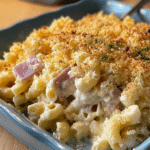
This Chicken Cordon Bleu Casserole is a creamy, cheesy baked pasta dish made with chicken, Swiss cheese, and a crispy golden breadcrumb topping.
- Prep Time: 15 minutes
- Cook Time: 30 minutes
- Total Time: 45 minutes
- Yield: 6 servings
- Category: Main Dish, Casserole
- Method: Bake
- Cuisine: American Fusion
Ingredients
- 1 lb cavatappi pasta
- 2 cans cream of chicken soup (10.5 oz each)
- 2 cups half & half
- 3 tbsp Dijon mustard
- 1 tbsp fresh parsley, chopped
- 1 tsp seasoned salt
- 1/2 tsp black pepper
- 3 cups shredded Swiss cheese
- 2 cups rotisserie chicken, diced
- 1 tbsp melted butter
- 3/4 cup panko breadcrumbs
- 1/4 cup grated Parmesan cheese
Instructions
- Preheat oven to 375°F (190°C) and grease a 9×13 baking dish.
- Cook pasta until al dente, drain and set aside.
- Mix cream of chicken soup, half & half, Dijon mustard, parsley, seasoning salt, and pepper.
- Add pasta, chicken, and Swiss cheese; mix well.
- Pour into baking dish and spread evenly.
- Mix breadcrumbs with melted butter and Parmesan, then sprinkle on top.
- Bake 25–30 minutes until bubbly and golden.
- Rest a few minutes before serving.
Notes
- Use rotisserie chicken for faster prep.
- Swiss cheese can be swapped with Gruyère for richer flavor.
- Add extra mustard for stronger Cordon Bleu taste.