
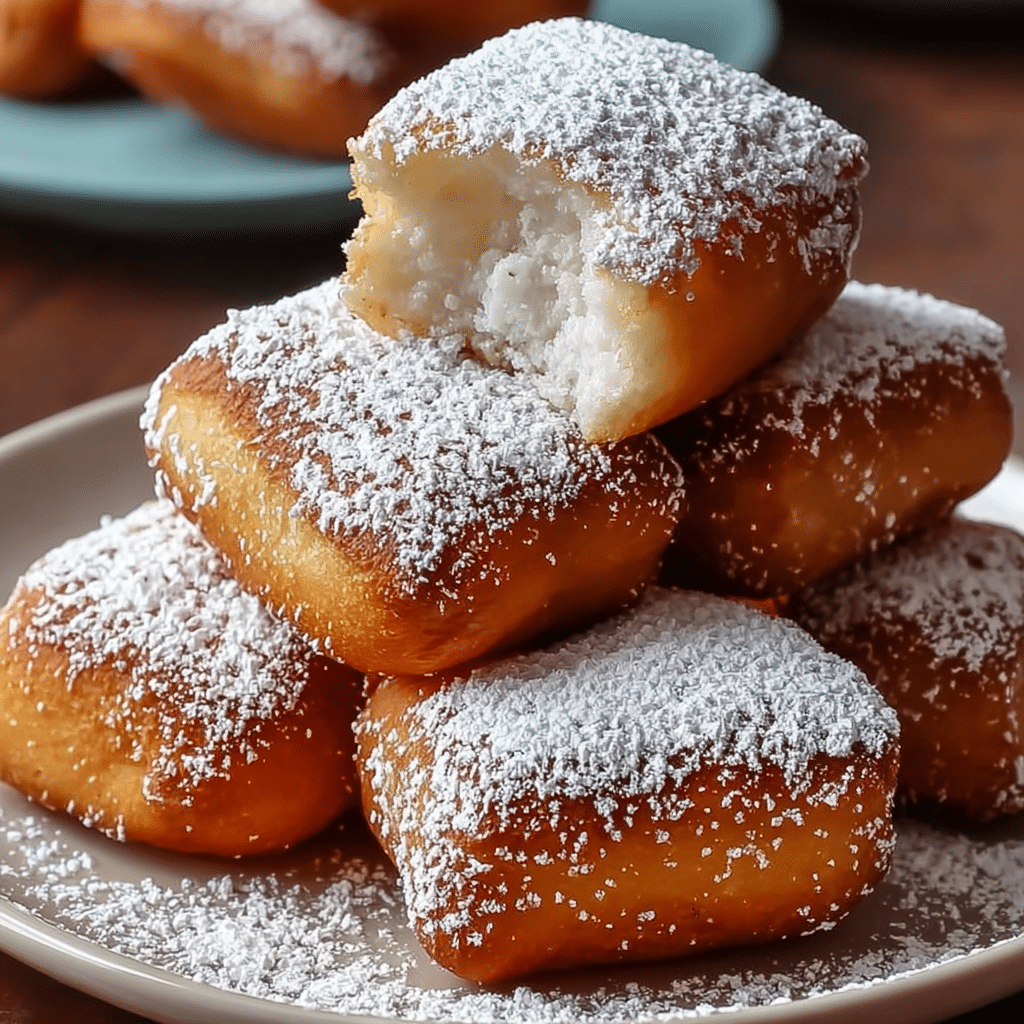
Close your eyes for a moment. Imagine you’re sitting at a tiny café in the French Quarter of New Orleans. The air is thick with the scent of chicory coffee and hot oil. In front of you sits a plate of golden, puffy pastries, buried under a blizzard of powdered sugar. You take a bite. The outside is delicately crisp. The inside is soft, airy, and impossibly light. Sugar dusts your fingers, your shirt, your soul.
That is a beignet. And now, you can make them at home.
These Vanilla French Beignets are everything you want in a morning treat: tender, pillowy, subtly sweet, and infused with the warm, aromatic flavor of real vanilla. They’re simpler to make than you might think—no complicated lamination, no rolling and folding like croissants. Just a soft yeast dough, a hot pot of oil, and a very generous hand with the powdered sugar.
Whether you’re bringing a taste of New Orleans to your kitchen, impressing guests at brunch, or just treating yourself to something spectacular on a slow Saturday morning, these beignets deliver. They’re pure, unapologetic joy in fried dough form.
Why You’ll Love This Recipe
- Café-quality beignets at home – No plane ticket to New Orleans required. Just a bowl, a pot, and a little patience.
- Soft, pillowy, and perfectly airy – The yeast dough creates those signature pockets of lightness.
- Real vanilla flavor – Vanilla extract in the dough elevates these beignets far beyond plain fried dough.
- Easier than you think – No complicated shaping. Just roll, cut, fry, and dust.
- Completely addictive – Warning: you will not be able to eat just one. Powdered sugar will get everywhere. It’s worth it.
Ingredients
- 1 cup warm milk (105-115°F) – Activates the yeast and adds richness. Whole milk is best, but 2% works too. Not too hot—you should be able to dip your finger in comfortably.
- 1/4 ounce active dry yeast (about 2 1/4 teaspoons) – The leavening agent that gives beignets their signature puff. One standard packet equals exactly 1/4 ounce.
- 1/4 cup granulated sugar – A touch of sweetness in the dough itself. Beignets aren’t cloying—the sugar dusting does most of the work.
- 1 large egg – Adds richness, structure, and a tender crumb.
- 1 teaspoon vanilla extract – The star of the show. Use pure vanilla extract if you can. It makes a difference.
- 1/2 teaspoon salt – Balances the sweetness and enhances all the flavors.
- 1/4 cup unsalted butter, melted – Adds richness, flavor, and a tender texture. Let it cool slightly before adding.
- 3 1/2 to 4 cups all-purpose flour – The structure. Start with 3 1/2 cups and add more as needed.
- Vegetable oil, for frying – Neutral oil with a high smoke point. Canola, peanut, or sunflower oil also work.
- Powdered sugar, for dusting – Lots and lots of powdered sugar. This is not a time for restraint.
How to Make Vanilla French Beignets
Step 1: Activate the Yeast
In a large bowl, combine the warm milk (105-115°F), active dry yeast, and a pinch of the granulated sugar. Stir gently. Let the mixture stand for 5–10 minutes. You’ll know it’s ready when the surface becomes foamy and bubbly. If nothing happens, your milk may have been too hot (killing the yeast) or too cold (failing to activate it). Start over with fresh yeast.
Step 2: Make the Dough
Whisk the remaining granulated sugar, the egg, vanilla extract, salt, and melted butter into the yeast mixture until well combined.
Gradually add the flour, 1 cup at a time, mixing with a wooden spoon or dough whisk until a soft, shaggy dough forms. You may not need all 4 cups—stop when the dough pulls away from the sides of the bowl.
Step 3: Knead the Dough
Turn the dough out onto a lightly floured surface. Knead for 5–7 minutes, adding small sprinkles of flour as needed to prevent sticking, until the dough becomes smooth, elastic, and slightly tacky but not sticky. To test: press the dough with your finger. It should bounce back slowly.
Step 4: First Rise
Lightly grease a large bowl with oil or cooking spray. Place the dough in the bowl, turning once to coat all sides. Cover the bowl with a clean kitchen towel or plastic wrap. Let it rise in a warm, draft-free place for 1 to 1.5 hours, until doubled in size. (Tip: Preheat your oven to its lowest setting for 1 minute, then turn it off. Place the covered bowl inside for a perfect warm environment.)
Step 5: Roll and Cut
Punch down the risen dough to release the air. Turn it out onto a lightly floured surface. Using a rolling pin, roll the dough into a large rectangle about 1/4 inch thick. Using a sharp knife or pizza cutter, cut the dough into 2–3 inch squares or rectangles. Traditional beignets are squares, but any shape works.
Step 6: Heat the Oil
Pour vegetable oil into a deep, heavy-bottomed pot or Dutch oven to a depth of about 2–3 inches. Heat the oil to 350°F (175°C). Use a deep-fry thermometer for accuracy. While the oil heats, line a plate or baking sheet with paper towels.
Step 7: Fry the Beignets
Working in small batches (3–4 beignets at a time, depending on pot size), carefully drop the dough squares into the hot oil. Do not overcrowd—this lowers the oil temperature and leads to greasy beignets. Fry for 1–2 minutes per side, until golden brown and puffed. The beignets will float and puff up dramatically. Use a slotted spoon or spider skimmer to flip them once.
Step 8: Drain and Dust
Remove the fried beignets with a slotted spoon and transfer them to the paper towel-lined plate to drain briefly. While still warm, transfer them to a serving plate and dust generously with powdered sugar. And when I say generously, I mean it. A proper beignet should look like a snowdrift.
Step 9: Serve Immediately
Beignets are best served warm, within minutes of frying. The powdered sugar will start to melt into the warm pastry, creating a sweet, crackly crust. Serve with coffee, café au lait, or hot chocolate.
Tips for Success
- Check your yeast – If your yeast mixture doesn’t get foamy after 10 minutes, your yeast is dead. Old yeast or water that’s too hot/cold are the usual culprits. Start over with fresh yeast.
- Don’t over-flour the dough – A slightly tacky dough is perfect. Too much flour makes dense, heavy beignets. Add flour gradually and stop as soon as the dough comes together.
- Keep the oil at 350°F (175°C) – Use a thermometer. Oil that’s too hot burns the outside before the inside cooks. Oil that’s too cool makes greasy, soggy beignets that absorb oil like sponges.
- Work in small batches – Overcrowding drops the oil temperature dramatically. Fry 3–4 beignets at a time and let the oil return to temperature between batches.
- Dust generously – There is no such thing as too much powdered sugar on a beignet. The sugar should be visible from space.
- Serve immediately – Beignets are at their absolute peak within 10 minutes of frying. They’re still good after that, but that light, airy magic fades.
Equipment Needed
- Large mixing bowl
- Wooden spoon or dough whisk
- Rolling pin
- Sharp knife or pizza cutter
- Deep, heavy-bottomed pot or Dutch oven (for frying)
- Deep-fry thermometer (essential for best results)
- Slotted spoon or spider skimmer
- Paper towels
- Fine-mesh sieve or powdered sugar duster
- Baking sheet (for resting cut dough)
Recipe Variations
Chocolate Beignets – Add 2 tablespoons of unsweetened cocoa powder to the flour mixture. Dust with powdered sugar as usual, or dust with a mixture of powdered sugar and cocoa powder. Serve with chocolate dipping sauce.
Citrus Vanilla Beignets – Add 1 tablespoon of finely grated lemon, orange, or grapefruit zest to the dough along with the vanilla extract. The bright, citrusy aroma pairs beautifully with the vanilla.
Cinnamon Sugar Beignets – Skip the powdered sugar. While the beignets are still warm, toss them in a mixture of 1/2 cup granulated sugar and 2 teaspoons of ground cinnamon. These have a warmer, spicier profile.
Espresso Vanilla Beignets – Add 1 tablespoon of instant espresso powder dissolved in 1 tablespoon of warm water to the dough. Dust with powdered sugar and serve with strong coffee. The coffee flavor intensifies the vanilla beautifully.
Stuffed Beignet Bites – After rolling out the dough, place a small square of chocolate, a teaspoon of Nutella, or a teaspoon of fruit jam in the center of half the dough squares. Top with another square and press the edges to seal. Fry as directed. Warning: the filling will be lava-hot. Let them cool for 1 minute before eating.
Savory Beignets – Omit the vanilla extract and reduce the sugar to 1 tablespoon. Add 1/2 cup of shredded Gruyère or cheddar cheese and 1 teaspoon of fresh thyme to the dough. Fry as directed and dust with flaky salt instead of powdered sugar. Serve alongside soup or salad.
Gluten-Free Beignets – Use a gluten-free all-purpose flour blend that contains xanthan gum (like King Arthur Measure for Measure or Bob’s Red Mill 1-to-1). The dough will be stickier; handle it gently and add a little extra flour as needed.
Serving Suggestions
Beignets are wonderful on their own, but the right accompaniments make them even better.
- Café au lait – Strong chicory coffee with hot milk. The classic New Orleans pairing.
- Hot chocolate – Thick, rich, and deeply chocolatey. Dip your beignets directly into it.
- Fresh berries – The tartness of raspberries, blackberries, or sliced strawberries cuts through the sweetness beautifully.
- Whipped cream – A dollop on the side adds creamy luxury.
- Chocolate sauce or caramel sauce – For dipping. Because more is more.
For a New Orleans brunch – Serve beignets alongside scrambled eggs, andouille sausage, and a big pot of café au lait. It’s a party on a plate.
For dessert – Pile beignets on a platter, dust heavily with powdered sugar, and serve with vanilla ice cream and warm chocolate sauce for dipping.
FAQs
Can I make the dough ahead of time?
Yes. After the first rise, punch down the dough, wrap it tightly in plastic wrap, and refrigerate for up to 24 hours. When you’re ready to fry, let the dough sit at room temperature for about 30 minutes before rolling and cutting.
Can I freeze beignet dough?
Absolutely. After the first rise, punch down the dough and wrap it tightly in plastic wrap, then place it in a freezer bag. Freeze for up to 2 months. Thaw overnight in the refrigerator, then let it come to room temperature before rolling and frying.
Can I freeze fried beignets?
You can, but they won’t be the same. Fried beignets lose their airy texture when frozen and reheated. If you must, freeze them in a single layer on a baking sheet, then transfer to a bag. Reheat in a 350°F (177°C) oven or air fryer for 3–5 minutes. Dust with fresh powdered sugar after reheating.
Why didn’t my beignets puff up?
Several possibilities. Your yeast may have been dead (the mixture didn’t foam). Your dough may have been over-kneaded or too dry. Or your oil temperature may have been off—oil that’s too low will make dense, oily beignets; oil that’s too high will brown the outside before the inside has time to puff.
Can I bake beignets instead of frying?
You can, but they won’t be true beignets. Baking produces a bread-like pastry that lacks the signature crisp exterior and airy interior. If you prefer to bake, shape the dough, brush with melted butter, and bake at 375°F (190°C) for 12–15 minutes. Dust with powdered sugar while warm.
What oil is best for frying beignets?
Vegetable oil, canola oil, peanut oil, or sunflower oil are all excellent. They have high smoke points and neutral flavors. Avoid olive oil (too low a smoke point, too strong a flavor) and coconut oil (the flavor will compete with the vanilla).
How do I get that perfect 1/4-inch thickness?
Use a rolling pin and roll evenly from the center outward. If you don’t have a rolling pin, a wine bottle or smooth glass works. Don’t roll too thin—1/4 inch is the sweet spot. Too thin, and the beignets will be crispy like crackers. Too thick, and they may not cook through.
My beignets are greasy. What went wrong?
Greasy beignets usually mean the oil temperature was too low. The dough absorbs oil instead of quickly forming a crisp crust. Next time, make sure your oil is at a steady 350°F (175°C) and don’t overcrowd the pot.
How long do beignets stay fresh?
Beignets are best within an hour of frying. After that, they lose their crisp exterior and become softer. They’re still delicious (especially if you re-dust with powdered sugar), but that magical just-fried texture fades quickly.
Can I make mini beignets?
Yes. Cut the dough into 1-inch squares instead of 2–3 inches. Fry for about 1 minute total, turning once. These are perfect for parties—popcorn-sized bites of fried dough heaven.
Final Thoughts
There is something almost spiritual about a perfect beignet. The way it puffs up in hot oil, transforming from a humble square of dough into a golden, airy cloud. The way the powdered sugar drifts down like snow and melts into the warm pastry. The way it disappears in three perfect bites, leaving behind a happy mess of sugar on your plate and a smile on your face.
These Vanilla French Beignets bring that experience to your kitchen. No passport required. No flight to New Orleans. Just a little patience, a little love, and a very generous hand with the powdered sugar.
So warm that milk. Proof that yeast. Roll out that dough. And when those golden pillows emerge from the hot oil, dust them like you mean it. Then take a bite, close your eyes, and let yourself be transported.
Tried this recipe? I’d love to hear how it turned out. Did you add chocolate? Serve them with café au lait? Make a double batch because one disappeared too fast? Leave a comment or tag your photo—and don’t forget to save this recipe for your next slow morning. Happy cooking
PrintVanilla French Beignets: Pillowy, Powdered Sugar-Dusted Clouds of Pure Joy

Vanilla French Beignets are light, fluffy deep-fried pastries with a hint of vanilla, finished with a generous dusting of powdered sugar for a classic café-style treat.
- Prep Time: 20 minutes
- Cook Time: 15 minutes
- Total Time: 1 hour 35 minutes
- Yield: 18 beignets
- Category: Dessert
- Method: Fry
- Cuisine: French
- Diet: Vegetarian
Ingredients
- 1 cup warm milk (105-115°F)
- 1/4 ounce active dry yeast (about 2 1/4 teaspoons)
- 1/4 cup granulated sugar
- 1 large egg
- 1 teaspoon vanilla extract
- 1/2 teaspoon salt
- 1/4 cup unsalted butter, melted
- 3 1/2 to 4 cups all-purpose flour
- Vegetable oil, for frying
- Powdered sugar, for dusting
Instructions
- In a large bowl, combine warm milk, yeast, and a pinch of sugar. Let stand 5–10 minutes until foamy.
- Whisk in remaining sugar, egg, vanilla extract, salt, and melted butter.
- Gradually add flour, mixing until a soft dough forms.
- Knead on a lightly floured surface for 5–7 minutes until smooth and elastic.
- Place dough in a greased bowl, cover, and let rise in a warm place for 1 to 1.5 hours until doubled.
- Punch down dough and roll out to about 1/4 inch thickness.
- Cut dough into 2–3 inch squares or rectangles.
- Heat oil to 350°F (175°C) and fry beignets a few at a time for 1–2 minutes per side until golden and puffed.
- Drain on paper towels and dust generously with powdered sugar. Serve warm.
Notes
- Do not overcrowd the fryer to maintain oil temperature.
- Best served fresh and warm the same day.
- Add cinnamon sugar instead of powdered sugar for variation.