
Introduction
In the modern family kitchen, time is the most precious ingredient. Between school pickups, work deadlines, after-school activities, and the endless hum of daily life, the prospect of preparing a wholesome, from-scratch dinner can feel daunting. Enter the one-pan meal: a culinary lifesaver that delivers flavor, nutrition, and satisfaction without mountains of dishes or hours of active cooking. Among the pantheon of sheet-pan suppers, One-Pan Honey Garlic Kielbasa & Veggies stands out as a true family delight—a dish that manages to be simultaneously effortless, elegant, and explosively flavorful.
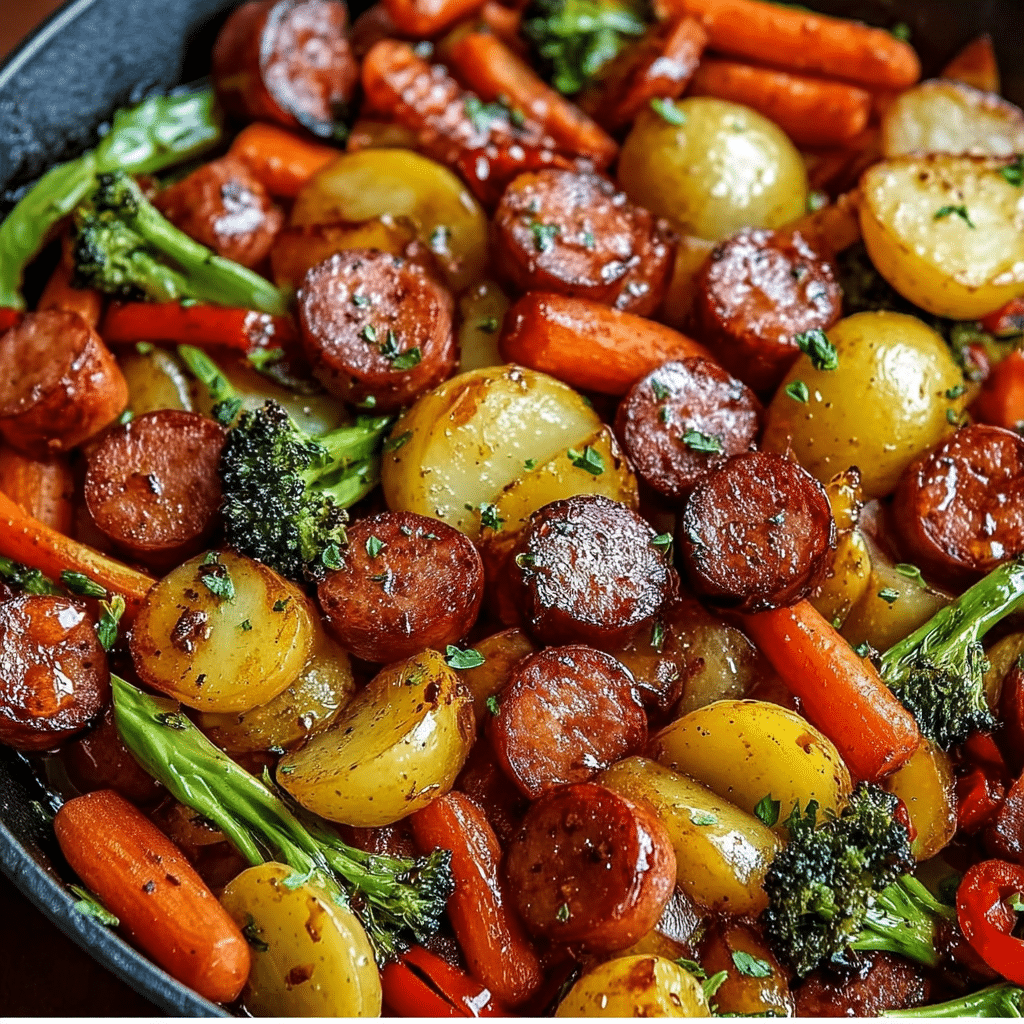
This recipe brings together the smoky, savory richness of Polish kielbasa with the caramelized sweetness of honey, the aromatic punch of fresh garlic, and the umami depth of soy sauce. All of this magic happens on a single baking sheet, surrounded by colorful, nutrient-dense vegetables: sweet red and yellow bell peppers, tender baby carrots, and creamy baby potatoes. As the oven works its alchemy at 400°F (200°C), the kielbasa develops crispy, caramelized edges, the potatoes turn golden and fork-tender, and the peppers soften into sweet, smoky perfection. The honey-garlic-soy glaze reduces into a sticky, glossy coating that clings to every surface, transforming humble ingredients into something crave-worthy.
What makes this dish so special is its balance of flavors and textures. The kielbasa provides a robust, meaty foundation with a pleasant snap. The honey adds sweetness that contrasts beautifully with the salty soy sauce. The garlic infuses everything with aromatic warmth. And the vegetables—each with its own unique texture—offer sweetness (carrots and bell peppers), creaminess (potatoes), and a slight char from roasting. A final shower of fresh parsley or green onions adds brightness and a professional finish.
This dish is also remarkably flexible. It welcomes substitutions—sweet potatoes instead of baby potatoes, zucchini or asparagus instead of bell peppers, turkey kielbasa for a lighter option. It scales up effortlessly for crowds and scales down for solo dinners. It is naturally gluten-free with a simple swap (tamari for soy sauce), and it can be made low-carb by replacing the potatoes with cauliflower or broccoli. In short, this is a recipe that adapts to your life, not the other way around.
This article will guide you through every aspect of creating this easy family delight. You will learn how to select the best kielbasa, why cutting vegetables to uniform size matters, how to achieve maximum caramelization without burning, and how to customize the recipe for dietary needs or picky eaters. We will cover ingredients, a step-by-step method, and conclude with a comprehensive FAQ section that answers every question you might have. Whether you are a busy parent, a college student cooking for the first time, or an experienced home cook seeking a reliable weeknight staple, this recipe belongs in your rotation.
Let us preheat the oven and get started.
Ingredients
The beauty of this recipe lies in its simplicity. You likely already have many of these ingredients in your pantry or refrigerator. Read through each item carefully, paying attention to quality notes and substitution suggestions.
For the Main Dish
- 1 lb kielbasa, sliced: Kielbasa is a Polish smoked sausage typically made from pork, though beef or turkey versions are available. High-quality kielbasa will have a firm texture, a visible coarse grind, and a deep, smoky flavor. Avoid cheap, overly processed brands that are mushy or bland. The sausage is already fully cooked, so you are roasting it to crisp the exterior and warm it through. Slice the kielbasa into ½-inch thick rounds or half-moons. Angling your knife on a slight bias creates larger, more elegant pieces. Look for kielbasa in the refrigerated meat case near other smoked sausages. If you cannot find kielbasa, smoked turkey sausage, andouille (for spicier results), or even chorizo (for a completely different flavor profile) can be substituted.
- 2 tbsp honey: Honey is not just a sweetener; it is a flavor carrier. Local honey is often less processed and contains floral notes from regional wildflowers, adding complexity to the glaze. The honey will caramelize in the oven, creating sticky, golden-brown edges on the kielbasa and vegetables. If you do not have honey, maple syrup or agave nectar can be substituted, though the flavor will change slightly. For a sugar-free version, use a sugar-free honey substitute or a sprinkle of brown sugar erythritol.
- 3 cloves garlic, minced: Fresh garlic is non-negotiable for the best results. The pungent, spicy, aromatic qualities of raw garlic mellow and sweeten as they roast, infusing the entire dish. Mince the garlic finely so it distributes evenly across the baking sheet. If you are a garlic lover, feel free to use 4 or 5 cloves. For a milder flavor, use 2 cloves. In a pinch, 1 teaspoon of jarred minced garlic or ½ teaspoon of garlic powder can substitute, but fresh is always superior.
- 2 tbsp soy sauce: Soy sauce provides the salty, umami backbone that balances the sweetness of the honey. Low-sodium soy sauce is an excellent choice here because the kielbasa is already salty, and you want to control overall sodium without sacrificing flavor. If you are gluten-free, substitute tamari or coconut aminos (use the same amount). For a soy-free version, use liquid aminos or a mixture of 1 tablespoon fish sauce and 1 tablespoon water (though the flavor will be distinctly different).
- 1 red bell pepper, chopped: Red bell peppers are the sweetest variety, with a mild, fruity flavor. They add vibrant color and a tender-crisp texture. Chop them into 1-inch pieces so they roast evenly without burning.
- 1 yellow bell pepper, chopped: Yellow bell peppers offer a similar sweetness to red peppers, with a slightly brighter, almost citrusy note. Using two colors creates visual appeal. Chop into 1-inch pieces. If bell peppers are not available or you prefer alternatives, zucchini (cut into half-moons) or asparagus (trimmed and cut into 2-inch pieces) work beautifully. Note that zucchini cooks faster, so add it halfway through roasting.
- 1 cup baby carrots: Baby carrots are convenient because they require no peeling or chopping. They add natural sweetness and a tender-crisp texture. If using full-sized carrots, peel them and cut them into 2-inch batons (sticks) of similar thickness to baby carrots. Carrots roast beautifully alongside potatoes.
- 1 lb baby potatoes (or sweet potatoes): Baby potatoes (such as Yukon Gold, red bliss, or fingerling) are ideal because their thin skins do not require peeling, and their small size means they cook quickly. Cut any larger baby potatoes in half or quarters so all pieces are roughly 1 inch in diameter. For a different nutritional profile and sweeter flavor, substitute 1 pound of sweet potatoes, peeled and cut into 1-inch cubes. Sweet potatoes will caramelize beautifully with the honey glaze.
- 2 tbsp olive oil: Olive oil helps the vegetables and kielbasa crisp and brown rather than steam. It also helps the honey-garlic-soy mixture adhere to everything. Use regular olive oil (not extra virgin, which has a lower smoke point) or any neutral oil with a high smoke point: avocado oil, grapeseed oil, canola oil, or vegetable oil all work perfectly.
For the Garnish
- 2 tbsp fresh parsley or green onions (for garnish): Fresh parsley (flat-leaf or curly) adds a bright, slightly peppery contrast to the rich, sweet, savory dish. Green onions (scallions) offer a mild onion bite and a pop of green. Use either or a combination of both. Chop them just before serving to preserve their freshness and vibrant color. Dried herbs will not work here; the garnish needs to be fresh to cut through the richness.
Equipment
- Large mixing bowl: For tossing the kielbasa and vegetables with the glaze.
- Baking sheet: A large, rimmed baking sheet (half-sheet pan, approximately 18×13 inches) is essential. Do not use a cookie sheet without sides, as juices may drip into your oven.
- Parchment paper: Lining the baking sheet with parchment paper ensures easy cleanup and prevents sticking. If you do not have parchment, aluminum foil lightly greased with cooking spray works as a backup.
- Spatula or tongs: For stirring the mixture halfway through roasting.
Preparation Method
This recipe could not be simpler. The oven does most of the work. Total active time is approximately 10 minutes; total oven time is 20–25 minutes. Serves 4 to 6 as a main dish.
Phase 1: Preheat and Prepare
Step 1: Preheat the oven.
Position an oven rack in the middle position. Preheat your oven to 400°F (200°C). A properly preheated oven is critical for achieving caramelization rather than steaming. Give your oven at least 15 minutes to reach temperature.
Step 2: Line the baking sheet.
Tear off a piece of parchment paper large enough to cover your baking sheet with some overhang on the sides. Press it flat. The parchment prevents sticking and makes cleanup almost nonexistent.
Step 3: Prepare all ingredients.
While the oven preheats, take out all ingredients. This recipe moves quickly once you start mixing. Here is what you need to do:
- Kielbasa: Slice the 1 lb of kielbasa into ½-inch thick rounds or half-moons. Do not cut too thin, or the kielbasa will dry out.
- Bell peppers: Remove the stems and seeds. Chop into 1-inch pieces.
- Baby carrots: If using full-sized carrots, peel and cut into 2-inch batons. Baby carrots can be used whole.
- Baby potatoes: Scrub them clean. Cut any potatoes larger than a golf ball in half or quarters so all pieces are roughly 1 inch in diameter.
- Garlic: Mince the 3 cloves finely.
- Parsley or green onions: Chop and set aside for garnish. Do not add to the baking sheet.
Phase 2: Combine and Toss
Step 4: Combine ingredients in a large bowl.
In a large mixing bowl, combine the sliced kielbasa, chopped red bell pepper, chopped yellow bell pepper, baby carrots, and baby potatoes.
Step 5: Add the glaze ingredients.
Drizzle the 2 tablespoons of olive oil over the kielbasa and vegetables. Add the 2 tablespoons of honey, the 3 cloves of minced garlic, and the 2 tablespoons of soy sauce.
Step 6: Toss until evenly coated.
Using your hands (clean, of course) or a large spoon, toss everything together thoroughly. Ensure every piece of kielbasa, every potato, every carrot, and every pepper piece is glistening with the honey-garlic-soy mixture. Pay special attention to breaking up any clumps of honey—it should be evenly distributed. If the honey is very thick, warm it slightly in the microwave for 10 seconds to make it more pourable.
Phase 3: Arrange on the Baking Sheet
Step 7: Spread in a single layer.
Transfer the mixture onto the prepared, parchment-lined baking sheet. Use your hands or a spatula to spread everything into an even, single layer. Overcrowding is the enemy of roasting. If the pieces are piled on top of each other, they will steam rather than caramelize. Each piece should have direct contact with the hot baking sheet. If necessary, use two baking sheets.
Step 8: Ensure even spacing.
Arrange the kielbasa slices so they are not touching each other if possible—this allows air to circulate and promotes browning on all sides. Vegetables can touch slightly, but avoid large clumps.
Phase 4: Roast
Step 9: Roast for 20–25 minutes.
Place the baking sheet in the preheated oven. Set a timer for 10 to 12 minutes (half the total roasting time).
Step 10: Stir halfway through.
After 10–12 minutes, remove the baking sheet from the oven (close the oven door to retain heat). Using a spatula or tongs, stir and flip the kielbasa and vegetables. This ensures even browning on all sides. Return the baking sheet to the oven.
Step 11: Check for doneness.
Roast for another 10–13 minutes, for a total of 20–25 minutes. The dish is ready when:
- The baby potatoes are fork-tender (a knife or fork slides in easily with little resistance).
- The baby carrots are tender but not mushy.
- The bell peppers have softened and have slight char marks on the edges.
- The kielbasa is browned, with caramelized, slightly sticky edges.
- The glaze has reduced and become glossy, coating everything.
If you prefer more caramelization and crispier edges, roast for an additional 2–3 minutes, watching carefully to prevent burning. Every oven is different, so use visual cues rather than strictly following the clock.
Phase 5: Garnish and Serve
Step 12: Remove from the oven.
Carefully remove the baking sheet from the oven. Place it on a heat-safe trivet or cooling rack.
Step 13: Garnish.
Sprinkle the 2 tablespoons of chopped fresh parsley or green onions evenly over the entire dish. The heat from the roasted vegetables will slightly wilt the herbs, releasing their aroma without cooking them completely.
Step 14: Serve hot.
Transfer to a serving platter or serve directly from the baking sheet (family-style, straight from the oven, is perfectly acceptable and charming). This dish pairs wonderfully with steamed rice, quinoa, crusty bread to soak up the juices, or a simple green salad. Leftovers (if there are any) store beautifully.
Conclusion
One-Pan Honey Garlic Kielbasa & Veggies is more than a recipe; it is a strategy for saner, more delicious weeknights. With just one baking sheet, a handful of wholesome ingredients, and about half an hour in the oven, you can produce a meal that tastes like you spent hours tending the stove. The smoky kielbasa, the sticky-sweet honey garlic glaze, and the roasted vegetables come together in a harmony of flavors that appeals to adults and children alike.
This dish is also a template for improvisation. Once you master the basic technique, you can swap in whatever protein and vegetables you have on hand—chicken sausage, broccoli, cauliflower, sweet potatoes, onions, Brussels sprouts, asparagus. The honey-garlic-soy formula works with almost anything. Keep this recipe in your back pocket for busy evenings, potluck dinners, and nights when you simply need dinner to happen without stress.
Below, you will find answers to the most frequently asked questions about this recipe, covering everything from vegetable substitutions to storage tips and dietary modifications.
Frequently Asked Questions (FAQ)
1. Can I use a different type of sausage instead of kielbasa?
Absolutely. Smoked turkey sausage, andouille (spicier), chicken apple sausage, or even chorizo all work well. Adjust cooking time slightly based on the sausage’s thickness and moisture content. Avoid raw sausages (like Italian sausage links) unless you cook them first, as they require longer roasting and may dry out. If using raw sausage, increase roasting time by 5–10 minutes and ensure the internal temperature reaches 160°F (71°C).
2. The honey burned on my baking sheet. What did I do wrong?
Honey is high in natural sugars, which caramelize quickly and can burn if exposed to high heat for too long. To prevent burning:
- Ensure your oven temperature is accurate—use an oven thermometer if you suspect your oven runs hot.
- Do not let the honey pool in large puddles; toss thoroughly so it coats thinly.
- Stir halfway through as directed to redistribute the glaze.
- If you see dark, smoking spots, remove the pan immediately. A little char is delicious (caramelization); black, bitter burning is not.
- If your oven tends to run hot, reduce the temperature to 375°F (190°C) and roast for 25–30 minutes.
3. Can I make this dish ahead of time?
Yes, with some caveats. The roasted vegetables and kielbasa can be prepared up to 2 days in advance. Store in an airtight container in the refrigerator. Reheat in a 350°F (175°C) oven for 8–10 minutes, or in a skillet over medium heat. The texture will not be as crisp as fresh (roasted vegetables lose their crispness upon refrigeration), but the flavor remains excellent. Do not garnish until just before serving.
4. How do I make this recipe low-carb or keto-friendly?
To make this dish low-carb or keto-friendly:
- Replace the potatoes: Use low-carb vegetables such as cauliflower florets, broccoli, zucchini, or Brussels sprouts. Cut them into similar-sized pieces.
- Replace the carrots: Use fewer carrots or omit them entirely (carrots are moderate in carbohydrates). Substitute green beans or asparagus.
- Sweetener: Use a sugar-free honey substitute or omit the honey and add an extra tablespoon of soy sauce plus a pinch of stevia or monk fruit sweetener.
- Kielbasa: Ensure your kielbasa is sugar-free (some brands add sugar to the curing process). Check labels.
- Soy sauce: Use coconut aminos for a lower-carb option (though it still contains some carbohydrates).
5. Can I add other vegetables?
Yes, this recipe is highly adaptable. Good additions include:
- Red onion: Cut into wedges or 1-inch pieces.
- Broccoli florets: Cut into bite-sized pieces.
- Cauliflower florets: Cut into bite-sized pieces.
- Brussels sprouts: Halved or quartered.
- Asparagus: Trimmed and cut into 2-inch pieces.
- Mushrooms: Whole if small, or halved.
- Zucchini: Cut into thick half-moons (add halfway through roasting to prevent mushiness).
- Butternut squash: Peeled and cut into 1-inch cubes.
If adding quick-cooking vegetables like zucchini or asparagus, add them halfway through roasting so they do not turn to mush. If adding denser vegetables like Brussels sprouts or butternut squash, they can go in at the beginning.
6. My vegetables are not crispy; they are soft and soggy. Why?
Soggy vegetables typically result from one of these issues:
- Overcrowding the baking sheet: If the pieces are piled on top of each other, they steam rather than roast. Use two baking sheets if necessary.
- Oven temperature too low: Ensure your oven is fully preheated to 400°F (200°C). Use an oven thermometer to verify.
- Too much oil or sauce: Excess liquid creates steam. Measure the oil and soy sauce carefully.
- Not stirring halfway through: Stirring redistributes the vegetables and promotes even browning.
- Vegetables cut too large: Large pieces take longer to cook and may become soft before they brown. Cut into 1-inch pieces.
7. Is this recipe gluten-free?
As written, no, because soy sauce contains wheat. To make it gluten-free:
- Soy sauce substitute: Use tamari (gluten-free soy sauce) or coconut aminos. Use the same amount (2 tablespoons).
- All other ingredients (kielbasa, honey, garlic, vegetables, olive oil, parsley) are naturally gluten-free. However, always check the kielbasa label—some brands add gluten-containing fillers or use gluten in the smoking process.
8. Can I cook this on a foil-lined sheet instead of parchment paper?
Yes. Line your baking sheet with aluminum foil and lightly grease it with cooking spray or a thin layer of oil. Foil may cause slightly more sticking than parchment, especially with the honey glaze, so greasing is essential. Alternatively, use a non-stick baking sheet without lining, though cleanup will be more difficult. If using foil, you can also lightly crumple it first, then flatten it—the slight texture can help reduce sticking.
9. How do I store and reheat leftovers?
Store leftovers in an airtight container in the refrigerator for up to 4 days. To reheat:
- Oven method (best for restoring crispness): Spread leftovers on a baking sheet and warm at 350°F (175°C) for 8–10 minutes.
- Skillet method: Warm in a non-stick skillet over medium heat for 5–6 minutes, stirring occasionally.
- Air fryer method (excellent): Reheat at 350°F for 3–5 minutes, shaking halfway through.
- Microwave method (quick but soft): Microwave on high for 90 seconds to 2 minutes, stirring halfway. The texture will be softer and less crisp.
Freezing is not recommended. The vegetables (especially potatoes and bell peppers) become mushy upon thawing, and the texture of the kielbasa degrades. If you must freeze, freeze for up to 1 month, but expect a significant change in texture.
10. Can I use fresh garlic instead of minced from a jar?
Yes, and fresh garlic is strongly preferred. Jarred minced garlic is often preserved in brine or oil and lacks the pungent, aromatic punch of fresh. Use 3 cloves of fresh garlic, peeled and minced finely. If you only have jarred garlic, use 1½ teaspoons, but know the flavor will be milder and slightly more acidic.
11. What should I serve with this dish?
This is a complete meal on its own, containing protein (kielbasa), vegetables (bell peppers, carrots), and starch (potatoes). However, here are some excellent accompaniments:
- Steamed rice or quinoa: To soak up extra glaze.
- Crusty bread: For sopping up the honey garlic sauce.
- Simple green salad: With lemon vinaigrette to cut through the richness.
- Roasted Brussels sprouts: For extra roasted vegetable goodness.
- Cauliflower rice: For a low-carb option.
- Cornbread: For a Southern-inspired meal.
12. Can I double this recipe for a crowd?
Yes. Use two separate baking sheets and rotate them halfway through roasting (swap top and bottom racks if using both racks). Do not crowd everything onto one sheet, or you will lose the caramelization and the vegetables will steam. Double all ingredients proportionally. Cooking time may increase by 5–10 minutes because the oven is more full, so check for doneness using visual cues rather than strictly following the timer.
13. My kielbasa released a lot of fat, and the vegetables are greasy. Is this normal?
Kielbasa is a fatty sausage, and some fat rendering is normal—in fact, that fat helps caramelize the vegetables. However, if the vegetables are greasy, try these adjustments:
- Do not add extra oil beyond the 2 tablespoons called for. The kielbasa will release its own fat.
- Spread everything in a single layer so fat can drip onto the parchment rather than pooling around vegetables.
- If you prefer a leaner dish, use turkey kielbasa, which has significantly less fat.
- Halfway through roasting, you can carefully tilt the baking sheet and blot excess fat with a paper towel (use tongs to hold the towel).
14. Can I prepare the glaze and toss everything the night before?
Yes, this is a great make-ahead strategy. Combine the sliced kielbasa, chopped vegetables, olive oil, honey, minced garlic, and soy sauce in a bowl or zip-top bag. Seal and refrigerate overnight. When ready to cook, spread on a parchment-lined baking sheet and roast as directed. You may need to add 2–3 minutes to the roasting time because the ingredients start cold from the refrigerator. Do not add the garnish until after roasting.
15. Can I use sweet potatoes instead of baby potatoes?
Yes, sweet potatoes are a delicious substitute. Peel the sweet potatoes (or scrub well if you prefer the skin on) and cut them into 1-inch cubes. Sweet potatoes have a higher sugar content than white potatoes, so they will caramelize more deeply and may become softer. Check for doneness at the 20-minute mark, as sweet potatoes can cook faster than white potatoes. The honey glaze pairs beautifully with the natural sweetness of sweet potatoes.
16. Why is this called a “family delight”?
Because it works for everyone. Children love the sweet, familiar flavor of honey and the mild, non-threatening vegetables (especially when the bell peppers are roasted soft). Adults appreciate the sophisticated sweet-savory balance, the minimal cleanup, and the fact that it feels special without requiring special effort. Picky eaters can easily pick around individual components (though the honey glaze tends to win them over). It is fast enough for a weeknight but impressive enough for company. It truly delights families.
17. Can I add a spicy kick to this dish?
Yes. Several options for adding heat:
- Red pepper flakes: Sprinkle ¼ to ½ teaspoon over the mixture before roasting.
- Cayenne pepper: Add ¼ teaspoon to the glaze mixture.
- Sriracha: Add 1 tablespoon of Sriracha to the glaze (reduce soy sauce slightly to maintain consistency).
- Chili garlic paste: Add 1 teaspoon to the glaze.
- Spicy kielbasa: Use andouille sausage or spicy smoked sausage instead of traditional kielbasa.
- Crushed red pepper garnish: Sprinkle over the finished dish before serving.
18. Can I use frozen vegetables instead of fresh?
Yes, with adjustments. Frozen vegetables have a higher water content than fresh and will release moisture as they roast, which can prevent caramelization. To use frozen:
- Do not thaw them first; add them frozen to the bowl.
- Increase the oven temperature to 425°F (218°C) to compensate for the extra moisture.
- Expect the vegetables to be softer and less crisp than fresh.
- Add frozen vegetables directly to the baking sheet (do not mix with the glaze in a bowl first, as the ice crystals will dilute the sauce).
- Best frozen options: frozen bell pepper strips, frozen broccoli, frozen cauliflower. Avoid frozen potatoes (they do not roast well).
19. Can I cook this dish in an air fryer?
Yes. An air fryer is excellent for this recipe. Here is how:
- Preheat the air fryer to 375°F (190°C).
- Toss the kielbasa and vegetables with the glaze as directed.
- Working in batches if necessary (do not overcrowd the basket), spread the mixture in a single layer in the air fryer basket.
- Cook for 12–15 minutes, shaking the basket halfway through.
- Check for doneness: vegetables should be tender and kielbasa caramelized.
- Garnish and serve. Air frying produces even crispier results than oven roasting.
20. Can I add pineapple to this dish?
Yes, pineapple is a wonderful addition that complements the honey garlic glaze. Add 1 cup of fresh or canned pineapple chunks (drained well if using canned). Add the pineapple to the baking sheet for the final 10 minutes of roasting only (if added at the beginning, it will release too much liquid and become mushy). The sweet-tart pineapple pairs beautifully with the savory kielbasa and the honey glaze. This variation is sometimes called “Hawaiian Kielbasa.”
PrintOne-Pan Honey Garlic Kielbasa & Veggies: Easy Family Delight
This one-pan honey garlic kielbasa and veggies is a quick, flavorful, and family-friendly meal with sweet and savory roasted goodness.
- Prep Time: 10 minutes
- Cook Time: 25 minutes
- Total Time: 35 minutes
- Yield: 4 servings
- Category: Main Dish
- Method: Roast
- Cuisine: American
Ingredients
- 1 lb kielbasa, sliced
- 2 tbsp honey
- 3 cloves garlic, minced
- 2 tbsp soy sauce
- 1 red bell pepper, chopped
- 1 yellow bell pepper, chopped
- 1 cup baby carrots
- 1 lb baby potatoes (or sweet potatoes)
- 2 tbsp olive oil
- 2 tbsp fresh parsley or green onions (for garnish)
Instructions
- Preheat oven to 400°F (200°C).
- Combine kielbasa, bell peppers, carrots, and potatoes in a large bowl.
- Drizzle olive oil, honey, soy sauce, and garlic over the mixture.
- Toss well until everything is evenly coated.
- Spread onto a parchment-lined baking sheet in a single layer.
- Roast for 20–25 minutes, stirring halfway through.
- Cook until vegetables are tender and kielbasa is caramelized.
- Remove from oven and garnish with parsley or green onions.
- Serve hot and enjoy.
Notes
- Swap potatoes for sweet potatoes or zucchini for variation.
- Use low-sodium soy sauce if preferred.
- Broil for 2–3 minutes at the end for extra caramelization.