
Introduction
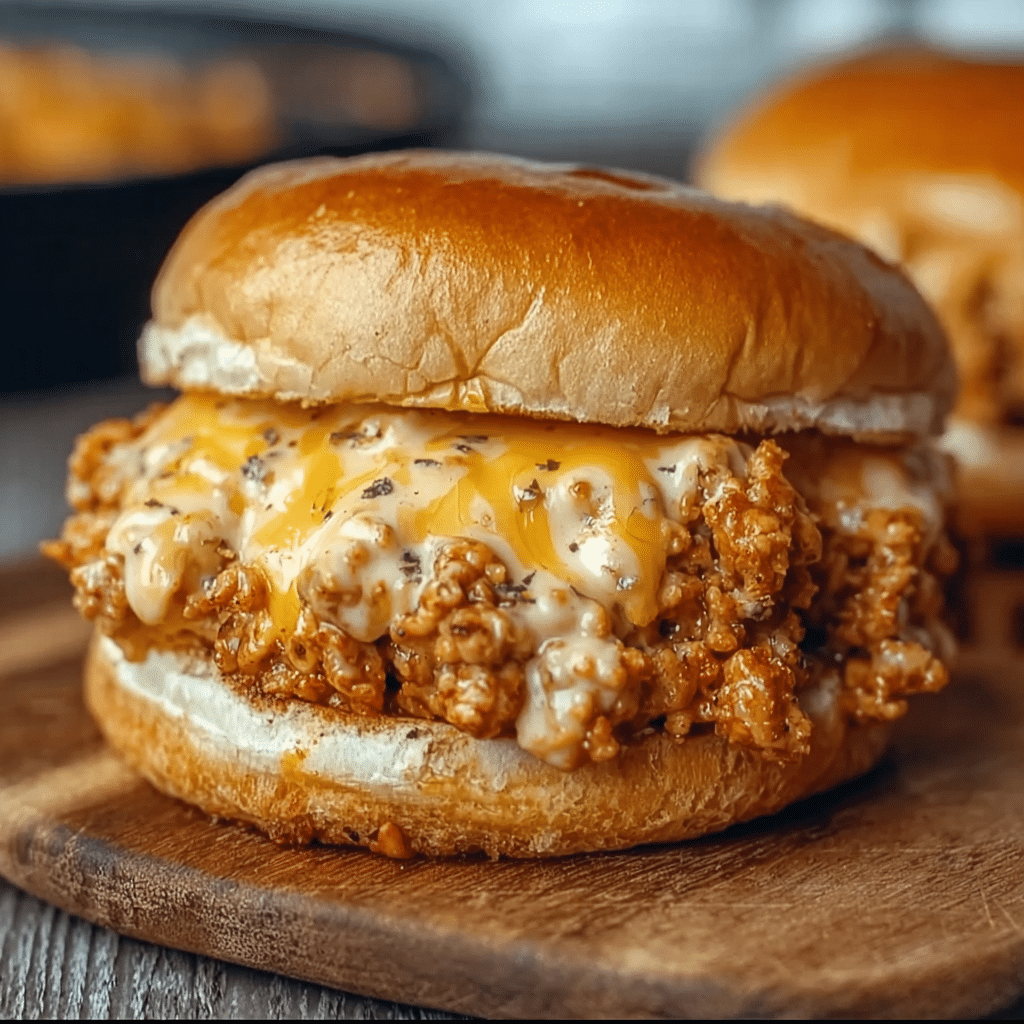
There are sandwiches that satisfy a hunger, and then there are sandwiches that create a memory. The Cajun Chicken Sloppy Joe with Creamy Cheese Sauce belongs emphatically to the latter category. It takes the nostalgic, messy, beloved American classic—the Sloppy Joe—and transports it to the bayous of Louisiana. This is not the sweet, ketchup-heavy version of your childhood. This is a bold, spicy, deeply savory evolution: succulent ground chicken simmered in a rich, tomato-based gravy perfumed with aromatic vegetables and punchy Cajun seasoning, then piled high onto a buttery, toasted brioche bun and drowned in a velvety, from-scratch cheese sauce.
At its heart, this recipe is a study in contrasts and harmonies. The ground chicken provides a lean, tender canvas that absorbs the flavors around it. The Cajun seasoning—a robust blend of paprika, cayenne, garlic powder, onion powder, oregano, thyme, and black pepper—delivers warmth, earthiness, and a building heat that awakens the palate. The tomato paste, tomato sauce, and chicken broth combine to create a thick, tangy, umami-rich sauce that clings to every crumb of meat. And then comes the cheese sauce: a classic béchamel transformed by the addition of sharp cheddar or American cheese and a whisper of paprika, offering a creamy, luxurious counterpoint to the spicy chicken. The toasted brioche bun, lightly buttered and golden, provides a sweet, rich vessel that holds everything together—just barely.
This article is your professional guide to mastering this extraordinary sandwich. We will explore each ingredient in detail, discuss the importance of proper roux technique, explain how to balance heat and creaminess, and provide a foolproof, step-by-step preparation method. Whether you are a home cook looking to elevate your weeknight dinner rotation or a culinary enthusiast seeking to understand the mechanics of building layered flavors, this guide will give you the confidence and knowledge to produce a perfect Cajun Chicken Sloppy Joe every single time.
Why does this recipe work so well? The answer lies in layering. You do not simply dump everything into a pot and hope for the best. Instead, you build flavors sequentially: browning the chicken to develop fond (the browned bits stuck to the pan), softening the aromatics to release their sweetness, blooming the Cajun seasoning and tomato paste to deepen their intensity, then deglazing with broth to capture every bit of flavor. The cheese sauce, made separately, follows its own precise path: a roux of butter and flour, slowly enriched with milk, then transformed into a silky emulsion with cheese. When these two components meet on a toasted bun, the result is a sandwich that is messy in the best possible way—juicy, creamy, spicy, and utterly irresistible.
The ingredient list you provided is complete and thoughtful. Each element serves a purpose. The optional brown sugar offers a subtle sweetness to balance the acidity and heat. The choice between sharp cheddar and American cheese for the sauce allows you to control the flavor profile and texture. The softened butter for toasting the buns is not an afterthought; it is a critical step that adds richness and prevents sogginess. By the end of this article, you will understand not just how to make this sandwich, but why each step matters.
Now, let us assemble our ingredients and begin the journey to the best Sloppy Joe you have ever tasted.
Ingredients
This recipe serves 4 to 6 people, making 4 very generous sandwiches or 6 modest ones. Ground chicken absorbs flavors beautifully but can dry out if overcooked, so precise timing is important.
For the Cajun Chicken Filling:
- 1 tablespoon olive oil – Use extra-virgin or regular olive oil. This is the cooking fat for browning the chicken and sautéing the aromatics. Its fruity notes complement the Cajun spices.
- 1 pound ground chicken – Look for ground chicken that is not too lean (93/7 or 85/15 is ideal). A little fat adds flavor and juiciness. Ground chicken thigh meat is superior to breast meat for this application. If you can only find extra-lean, add an extra teaspoon of olive oil.
- 1 small onion, finely chopped – Yellow or white onion works best. Finely chopping (about 1/4-inch dice) ensures the onion melts into the sauce rather than leaving large, crunchy pieces. You should have approximately 3/4 cup of chopped onion.
- 2 cloves garlic, minced – Fresh garlic is non-negotiable. Mince it finely or use a garlic press. Do not use jarred, pre-minced garlic, which has a harsh, acrid flavor.
- 2 tablespoons Cajun seasoning – This is the flavor backbone. Use a store-bought blend (look for one without added salt, or adjust your salt accordingly) or make your own (see FAQ for a recipe). A good Cajun seasoning contains paprika, cayenne, garlic powder, onion powder, dried oregano, dried thyme, black pepper, and sometimes white pepper.
- 1 tablespoon tomato paste – Tomato paste adds concentrated umami, depth, and a rich red color. It also helps thicken the sauce. Use the kind that comes in a small tube or can. Leftover paste can be frozen in tablespoon-sized portions.
- 1/2 cup chicken broth – Use low-sodium or regular chicken broth. This deglazes the pan and forms the liquid base of the sauce. Vegetable broth works in a pinch, but chicken broth adds more savory depth.
- 1/2 cup tomato sauce – Plain, unseasoned tomato sauce. Not marinara, not pasta sauce. This adds body and acidity. Canned tomato sauce is perfect.
- 1 tablespoon Worcestershire sauce – This fermented condiment adds umami, tanginess, and a subtle sweetness. It is a key flavor bridge between the savory chicken and the tomato.
- 1 teaspoon brown sugar (optional) – A small amount of brown sugar balances the acidity of the tomato and the heat of the Cajun seasoning. It is optional but recommended unless you prefer a very tangy, spicy profile.
- Salt to taste – Add salt at the end after tasting, as Cajun seasoning and broth may already contain salt.
- Freshly ground black pepper – For finishing the sandwich. Use coarsely ground black pepper for a fresh, pungent kick.
For Assembly and Toasting:
- 4–6 brioche hamburger buns, toasted – Brioche buns are slightly sweet, rich, and buttery, which complements the spicy, savory filling. If brioche is unavailable, use potato rolls or high-quality hamburger buns. You need 4 to 6 depending on how generously you fill them.
- Softened butter (for toasting) – Unsalted butter, softened to room temperature for easy spreading. This is essential for achieving a golden, crispy, flavorful toast on the buns.
For the Creamy Cheese Sauce:
- 2 tablespoons unsalted butter – The fat base for the roux. Unsalted butter allows you to control the salt level.
- 2 tablespoons all-purpose flour – The thickening agent. Combined with butter, this forms a roux that will thicken the milk into a creamy béchamel.
- 1 cup whole milk – Whole milk (3.25% milk fat) creates the creamiest, richest cheese sauce. Lower-fat milks will work but produce a thinner, less luxurious sauce. Do not use non-dairy milks without understanding that they may not thicken properly.
- 8 ounces sharp cheddar or American cheese, shredded – This is your cheese choice. Sharp cheddar provides a bold, tangy, complex flavor and a slightly firmer texture when melted. Shred it yourself from a block; pre-shredded cheese contains anti-caking agents that prevent smooth melting. American cheese (from the deli counter, not individually wrapped slices) melts into an ultra-smooth, velvety, almost fondue-like sauce with a milder, creamier flavor. Both are excellent. Choose based on your preference.
- 1/4 teaspoon paprika – Sweet paprika, not smoked or hot. This adds a subtle earthy sweetness and a hint of color to the cheese sauce, tying it visually and flavorfully to the Cajun chicken.
Special Equipment:
- Large skillet or sauté pan (12-inch / 30cm) – for the chicken filling
- Medium saucepan (2-quart / 2-liter) – for the cheese sauce
- Whisk – essential for a lump-free roux and cheese sauce
- Wooden spoon or silicone spatula
- Small bowl for the roux (optional)
- Pastry brush – for buttering the buns
- Cutting board and sharp knife
- Measuring cups and spoons
- Cheese grater (if shredding your own cheese)
Preparation Method
This method is divided into three parallel tracks: preparing the Cajun chicken filling, making the creamy cheese sauce, and toasting the buns. Read through the entire method before beginning. The cheese sauce and chicken filling can be made simultaneously if you are comfortable multitasking, but first-time makers should complete the chicken filling first, then make the cheese sauce while the chicken rests.
Phase 1: Prepare the Cajun Chicken Filling
This phase builds flavor in layers. Do not rush the browning or the simmering.
Step 1.1: Brown the ground chicken.
Place the large skillet over medium-high heat. Add the 1 tablespoon of olive oil. Heat until the oil shimmers (about 1 minute). Add the 1 pound of ground chicken. Use a wooden spoon or spatula to break the meat into small, bite-sized pieces. Cook without stirring for the first 2 minutes to allow the bottom to brown. Then stir and continue cooking, breaking up any large clumps, until the chicken is no longer pink and has developed golden-brown edges. This should take 5-7 minutes. Do not drain the fat; ground chicken is lean enough that any rendered fat will add flavor.
Step 1.2: Add the aromatics.
Add the finely chopped small onion to the skillet with the browned chicken. Cook for 3-4 minutes, stirring occasionally, until the onion becomes translucent and soft. Add the 2 minced garlic cloves and the 2 tablespoons of Cajun seasoning. Stir constantly for 1 minute. This step, called “blooming,” releases the essential oils in the spices and garlic, making them far more aromatic and flavorful. Your kitchen will smell intensely of warm spices.
Step 1.3: Incorporate the tomato paste.
Add the 1 tablespoon of tomato paste to the skillet. Stir it into the chicken and onion mixture. Cook for 2 minutes, stirring frequently. The tomato paste will darken slightly and begin to stick to the bottom of the pan. This caramelization is desirable—it adds deep, savory, umami notes. Do not let it burn (blackened or acrid smell). If it sticks too aggressively, reduce the heat slightly.
Step 1.4: Deglaze and simmer.
Pour in the 1/2 cup of chicken broth. Use your wooden spoon to scrape up any browned bits (fond) from the bottom of the pan. These bits are packed with flavor. Then add the 1/2 cup of tomato sauce and the 1 tablespoon of Worcestershire sauce. Stir everything together until well combined. Bring the mixture to a gentle boil, then reduce the heat to medium-low. Simmer uncovered for 8-10 minutes, stirring occasionally. The sauce will thicken and reduce slightly. You are looking for a consistency that is moist and spoonable but not watery. When you drag a spoon through the mixture, it should leave a brief trail before the sauce slowly fills it in.
Step 1.5: Final seasoning.
Taste the filling. Add salt to taste—start with 1/4 teaspoon and go up from there. Remember that the cheese sauce will add saltiness as well, so under-salt slightly. If using the optional 1 teaspoon of brown sugar, add it now and stir to dissolve. If the filling seems too thick, add a splash (1-2 tablespoons) of additional chicken broth. If it seems too thin, simmer for another 2-3 minutes uncovered. Remove the skillet from the heat and cover loosely to keep warm while you prepare the cheese sauce.
Phase 2: Make the Creamy Cheese Sauce
This cheese sauce is a classic Mornay sauce (a béchamel with cheese). Precision with heat is critical: too hot and the sauce will break or become grainy; too cold and the cheese will not melt smoothly.
Step 2.1: Make the roux.
In the medium saucepan, melt the 2 tablespoons of unsalted butter over medium heat. Once the butter is fully melted and stops foaming, add the 2 tablespoons of all-purpose flour. Whisk immediately and continuously. Cook the mixture (the roux) for 1 minute. It should be pale golden and smell slightly nutty. Do not let it brown beyond pale gold; a dark roux is for gumbo, not cheese sauce. The purpose of cooking the roux is to eliminate the raw flour taste.
Step 2.2: Add the milk.
Slowly pour in the 1 cup of whole milk while whisking constantly. Pour in a thin stream; this prevents lumps from forming. Continue whisking until the mixture is smooth and there are no visible lumps of flour. Turn the heat to medium-high and bring the mixture to a gentle simmer, whisking frequently. You will feel the sauce thicken noticeably. This takes 3-4 minutes. The sauce should be thick enough to coat the back of a spoon: when you run your finger through the sauce on the spoon, a clear line should remain.
Step 2.3: Incorporate the cheese.
Reduce the heat to low. Add the 8 ounces of shredded sharp cheddar or American cheese in three batches, whisking after each addition until the cheese is fully melted and the sauce is smooth. Do not add all the cheese at once, as this can overwhelm the emulsion and cause graininess. After the last batch of cheese is incorporated, add the 1/4 teaspoon of paprika and whisk to combine.
Critical warning: Do not let the cheese sauce boil. Boiling will cause the proteins in the cheese to seize and separate, resulting in a greasy, grainy, broken sauce. Keep the heat on low or warm. If the sauce is too thick, whisk in an extra tablespoon of warm milk. If it is too thin, continue whisking over low heat for another minute—it will thicken as it cools slightly.
Step 2.4: Hold the cheese sauce.
Remove the saucepan from the heat. Cover the surface of the cheese sauce directly with plastic wrap or a lid. This prevents a skin from forming. The sauce can be held warm for up to 30 minutes. If it becomes too thick before serving, reheat gently over low heat, whisking in a tablespoon of milk at a time.
Phase 3: Toast the Brioche Buns
Toasting is not optional. A soft, untoasted bun will become sodden and collapse under the weight of the filling and cheese sauce.
Step 3.1: Butter the buns.
Take the 4-6 brioche hamburger buns. Split them open if they are not already. Using a pastry brush or a butter knife, spread a thin, even layer of softened butter on the cut sides of both the top and bottom buns. Do not skip the top bun—toasting both sides adds structural integrity and flavor.
Step 3.2: Toast until golden.
Heat a clean, dry skillet over medium heat (or use a griddle). Place the buns cut-side down in the skillet. Toast for 1-2 minutes until the buttered surface is golden brown and crisp. Do not press down on the buns; let them toast naturally. Alternatively, toast under a broiler for 30-60 seconds, watching carefully to prevent burning. Set the toasted buns aside on a serving platter or individual plates.
Phase 4: Assemble the Sandwiches
Assembly should be swift. Have everything within reach.
Step 4.1: Spoon the Cajun chicken.
Place the bottom half of each toasted brioche bun on a plate. Using a slotted spoon (to drain excess liquid if desired, though the sauce is part of the experience), spoon a generous portion of the Cajun chicken filling onto each bottom bun. For 4 sandwiches, use approximately 1/2 cup of filling per bun. For 6 sandwiches, use about 1/3 cup.
Step 4.2: Add the cheese sauce.
Spoon or drizzle the warm creamy cheese sauce generously over the chicken filling. Do not be shy—this is a “creamy cheese sauce” sandwich. Use approximately 2-3 tablespoons of cheese sauce per sandwich.
Step 4.3: Finish with black pepper and the top bun.
Sprinkle freshly ground black pepper over the cheese sauce. The pepper adds a bright, pungent contrast to the rich, creamy, spicy flavors. Place the top bun (toasted side down) onto each sandwich. Press down gently to set.
Step 4.4: Serve immediately.
Cajun Chicken Sloppy Joes are best eaten the moment they are assembled. Provide plenty of napkins. Serve with pickles, coleslaw, or a simple green salad to cut through the richness.
Conclusion
You have just created a sandwich that defies expectations. The Cajun Chicken Sloppy Joe with Creamy Cheese Sauce is not a relic of the school cafeteria; it is a sophisticated, deeply flavorful, texturally complex meal that happens to be wonderfully messy. By using the ingredients you provided—olive oil, ground chicken, onion, garlic, Cajun seasoning, tomato paste, chicken broth, tomato sauce, Worcestershire sauce, optional brown sugar, salt, brioche buns, softened butter, black pepper, unsalted butter, flour, whole milk, sharp cheddar or American cheese, and paprika—you have produced a dish that balances heat, creaminess, acidity, and savory depth in perfect harmony.
Let us reflect on the techniques that made this possible. The sequential layering of flavors—browning the chicken, softening the onion, blooming the spices, caramelizing the tomato paste, deglazing with broth—is the foundation of all great braised and stewed dishes. The separate cheese sauce, built from a carefully cooked roux and gently melted cheese, demonstrates that creamy sauces do not come from a jar or a powder; they come from patience and precise heat control. The toasted, buttered brioche bun is not a vessel but an active participant, adding sweetness, richness, and structural integrity.
This recipe is also remarkably adaptable. The optional brown sugar allows you to dial in the sweetness to your preference. The choice between sharp cheddar and American cheese changes the cheese sauce from bold and tangy to ultra-smooth and mild. You can adjust the Cajun seasoning up or down depending on your heat tolerance. You can even swap the ground chicken for ground turkey, pork, or beef, though the flavor profile will shift.
Below, you will find detailed answers to the most common questions about this recipe. These FAQs address ingredient substitutions, troubleshooting common problems (grainy cheese sauce, dry filling, soggy buns), storage and reheating, and dietary adaptations. Whether you are wondering about making your own Cajun seasoning, how to fix a broken cheese sauce, or whether you can freeze the filling, you will find the answer here.
Frequently Asked Questions (FAQs)
Q1: Can I use ground turkey instead of ground chicken?
Yes, absolutely. Ground turkey has a similar texture and leanness to ground chicken. Use 93/7 or 85/15 ground turkey for the best results. Follow the exact same browning and cooking instructions. Ground turkey can be slightly drier than chicken, so consider adding an extra tablespoon of chicken broth at the end if the filling seems too dry.
Q2: My cheese sauce turned out grainy or greasy. What went wrong?
Grainy or greasy cheese sauce is almost always caused by one of three issues:
- Heat too high. You boiled the sauce after adding the cheese. Cheese sauces must never boil. Always keep the heat on low when adding and melting the cheese.
- Pre-shredded cheese. Pre-shredded cheese is coated with cellulose and potato starch to prevent clumping. These anti-caking agents prevent smooth melting. Always shred your own cheese from a block.
- Cheese added too quickly. Adding all the cheese at once can overwhelm the emulsion. Add it in three batches, whisking fully between each.
If your sauce has already broken, you can sometimes rescue it by whisking in a tablespoon of cold milk or a splash of cream off the heat. If that fails, unfortunately, you must start over.
Q3: Can I make this recipe dairy-free?
Yes, with careful substitutions. For the cheese sauce, use a dairy-free butter substitute (like plant-based butter), a gluten-free all-purpose flour (if needed), unsweetened oat milk or soy milk (these have the best thickening properties), and a dairy-free shredded cheese (look for brands like Violife or Daiya that are designed to melt). Note that dairy-free cheese behaves differently; it may not become as smooth as dairy cheese. For the brioche buns, use dairy-free brioche or a vegan hamburger bun. Omit the butter for toasting or use a dairy-free spread.
Q4: The Cajun chicken filling is too spicy / not spicy enough. How can I adjust it?
Cajun seasoning blends vary dramatically in heat level. To adjust:
- Too spicy: Add an extra 1/4 cup of tomato sauce and a teaspoon of brown sugar. The sweetness and acidity will temper the heat. You can also serve with extra cheese sauce, which cools the palate.
- Not spicy enough: Add an additional 1/2 teaspoon of cayenne pepper or a teaspoon of hot sauce (like Tabasco or Crystal) at the same time you add the broth. Alternatively, add a pinch of red chili pepper flakes.
For future batches, taste your Cajun seasoning before using it. If it is extremely hot, reduce the quantity to 1 tablespoon.
Q5: Can I use a different cheese for the cheese sauce?
Yes, but with caveats. The best melting cheeses are sharp cheddar, American, Monterey Jack, Gruyère, or fontina. Do not use pre-shredded cheese blends. Do not use cheeses with low melting points like fresh mozzarella (becomes stringy and watery) or hard cheeses like Parmesan (too salty and grainy on its own). A combination of sharp cheddar and Monterey Jack is excellent.
Q6: My buns became soggy immediately. What did I do wrong?
Soggy buns are a common Sloppy Joe problem. Here is how to prevent it:
- Toast thoroughly. The buns should be deep golden brown, not just pale and warm. A proper crust resists moisture.
- Do not over-sauce the filling. The chicken filling should be moist but not swimming in liquid. If you have excess liquid in the skillet, use a slotted spoon to transfer the meat to the buns.
- Serve immediately. Even perfectly toasted buns will eventually absorb moisture. Assemble and serve within 2-3 minutes.
- Consider a “moisture barrier.” In restaurant settings, chefs sometimes spread a thin layer of butter or mayonnaise on the toasted bun before adding the filling. The fat repels moisture.
Q7: Can I make the Cajun chicken filling ahead of time?
Yes, and it often tastes better the next day as the flavors meld. Prepare the filling through Step 1.5. Let it cool completely, then store in an airtight container in the refrigerator for up to 4 days. Reheat gently in a skillet over medium-low heat, adding a splash of chicken broth if it has thickened too much. Make the cheese sauce fresh when ready to serve, as reheated cheese sauce is rarely as smooth.
Q8: Can I freeze the Cajun chicken filling?
Absolutely. The chicken filling freezes beautifully. Cool it completely, then transfer to freezer-safe bags or containers. Freeze for up to 3 months. Thaw overnight in the refrigerator. Reheat in a skillet over medium heat, adding 1/4 cup of chicken broth to restore the saucy consistency. Do not freeze the cheese sauce; it will become grainy and separated upon thawing.
Q9: I don’t have Cajun seasoning. Can I make my own?
Yes, and it is simple. Mix together the following:
- 1 tablespoon paprika
- 1 teaspoon cayenne pepper (adjust to heat preference)
- 1 teaspoon garlic powder
- 1 teaspoon onion powder
- 1 teaspoon dried oregano
- 1 teaspoon dried thyme
- 1 teaspoon black pepper
- 1/2 teaspoon white pepper (optional)
This makes approximately 3 tablespoons of Cajun seasoning. Use 2 tablespoons in the recipe and save the rest for another use. Omit any additional salt in the spice blend, as you will add salt separately.
Q10: The recipe calls for sharp cheddar or American cheese. Which is better?
Neither is objectively better; they produce different results. Sharp cheddar gives you a bold, tangy, complex cheese sauce with a slightly firmer texture. It pairs beautifully with the spicy Cajun chicken. American cheese (from the deli counter, not individually wrapped slices) produces an ultra-smooth, velvety, mild sauce that is incredibly luxurious. It melts more easily and is more forgiving. For the best of both worlds, use 4 ounces of sharp cheddar and 4 ounces of American cheese.
Q11: Can I add vegetables to the filling?
Yes. Diced bell peppers (red, green, or yellow) are a classic addition to Sloppy Joes and pair well with Cajun flavors. Add 1/2 cup of finely diced bell pepper along with the onion in Step 1.2. You can also add finely diced celery for crunch. Cook until softened before adding the garlic and spices.
Q12: The cheese sauce thickened too much before serving. How do I thin it?
Cheese sauce naturally thickens as it cools. To thin it, reheat gently over low heat. Whisk in whole milk one tablespoon at a time until the desired consistency returns. Do not add water, which will make the sauce thin and bland. Do not microwave the cheese sauce on high power, as this will cause it to break.
Q13: Can I use a different type of bun besides brioche?
Yes, though brioche is ideal for its richness. Good substitutes include potato rolls (soft and slightly sweet), challah buns (similar to brioche), or high-quality classic hamburger buns. Avoid very dense or whole-grain buns, which can compete with the flavors of the filling and cheese sauce. Avoid pretzel buns, which are too salty and chewy for this application.
Q14: Why is there no salt in the cheese sauce ingredients?
The cheese sauce gets its salt from the cheese itself. Sharp cheddar and American cheese are both quite salty. Adding additional salt to the cheese sauce would likely make the entire sandwich overly salty, especially when combined with the seasoned chicken filling. Taste the assembled sandwich before adding any extra salt to the cheese sauce. The 1/4 teaspoon of paprika provides color and a hint of flavor but no salt.
Q15: Can I make this sandwich in a slow cooker or Instant Pot?
For the chicken filling only, yes. For the cheese sauce, no—make it separately on the stovetop.
- Slow cooker: Brown the chicken and sauté the onion, garlic, and spices in a skillet first (Steps 1.1-1.3). Transfer to a slow cooker. Add the tomato paste, broth, tomato sauce, and Worcestershire sauce. Cook on LOW for 2-3 hours. Stir in brown sugar and salt at the end.
- Instant Pot: Use the Sauté function for Steps 1.1-1.3. Add the liquids, then pressure cook on HIGH for 5 minutes with a natural release (10 minutes). The texture will be softer than stovetop version.
In both cases, the cheese sauce must be made fresh on the stovetop.
Q16: This recipe seems rich and heavy. What should I serve alongside it?
You are correct—this is an indulgent sandwich. Balance it with lighter, fresher sides:
- Tangy coleslaw (vinegar-based, not creamy)
- Pickled vegetables (cucumbers, red onions, or okra)
- Simple green salad with lemon vinaigrette
- Corn on the cob (grilled or boiled, lightly seasoned)
- Celery sticks and carrot sticks for crunch and freshness
Avoid serving with french fries or onion rings, which would make the meal overwhelmingly heavy.
Cajun Chicken Sloppy Joes with Creamy Cheese Sauce
Flavor-packed Cajun Chicken Sloppy Joes topped with a rich, creamy cheese sauce. A bold and comforting twist on a classic sandwich, perfect for quick dinners.
- Prep Time: 15 minutes
- Cook Time: 25 minutes
- Total Time: 40 minutes
- Yield: 4–6 servings
- Category: Main Dish
- Method: Stovetop
- Cuisine: American
Ingredients
- 1 tbsp olive oil
- 1 lb ground chicken
- 1 small onion, finely chopped
- 2 cloves garlic, minced
- 2 tbsp Cajun seasoning
- 1 tbsp tomato paste
- 1/2 cup chicken broth
- 1/2 cup tomato sauce
- 1 tbsp Worcestershire sauce
- 1 tsp brown sugar (optional)
- Salt to taste
- 4–6 brioche hamburger buns, toasted
- Softened butter (for toasting)
- Freshly ground black pepper
- 2 tbsp unsalted butter (cheese sauce)
- 2 tbsp all-purpose flour
- 1 cup whole milk
- 8 oz sharp cheddar or American cheese, shredded
- 1/4 tsp paprika
Instructions
- Heat olive oil in a skillet over medium-high heat. Add ground chicken and cook until no longer pink, breaking it apart.
- Add onion and cook until softened, then stir in garlic and Cajun seasoning for 1 minute.
- Mix in tomato paste until chicken is coated and rich in color.
- Add chicken broth, tomato sauce, and Worcestershire sauce. Simmer 8–10 minutes until thickened.
- Season with salt and optional brown sugar. Adjust consistency with a splash of broth if needed.
- In a saucepan, melt butter. Whisk in flour and cook 1 minute to form a roux.
- Slowly whisk in milk and cook until slightly thickened.
- Lower heat and stir in cheese and paprika until smooth. Do not boil.
- Butter and toast brioche buns until golden.
- Spoon Cajun chicken onto buns, top generously with cheese sauce, and finish with black pepper.
Notes
- Use sharp cheddar for stronger flavor or American cheese for extra creaminess.
- Adjust Cajun seasoning to control spice level.
- Serve immediately for best texture and flavor.