
Introduction
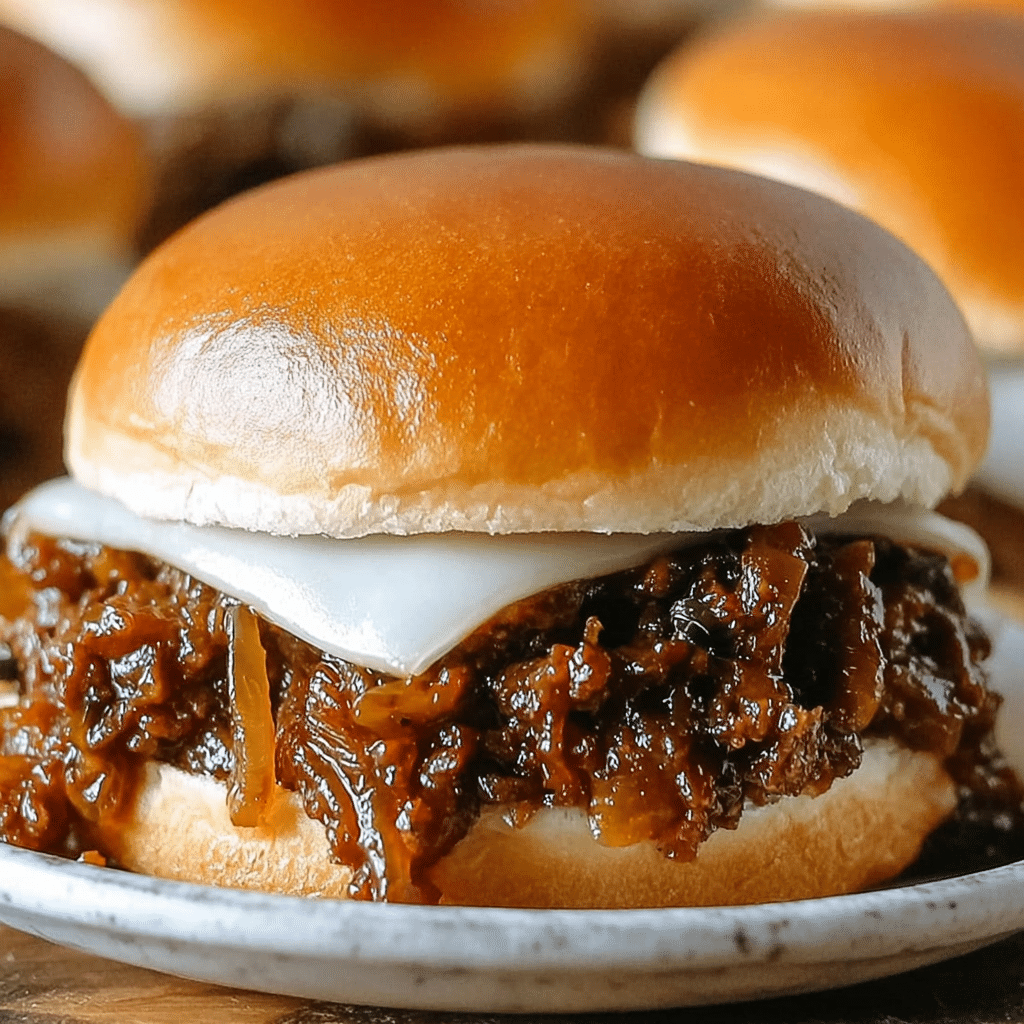
There are sandwiches that satisfy a craving, and then there are sandwiches that redefine what a sandwich can be. The French Onion Beef Sloppy Joe belongs to the latter category. It takes the soulful, deeply savory essence of French onion soup—that legendary combination of caramelized onions, rich beef broth, and melted Gruyère or Swiss cheese—and marries it with the messy, nostalgic, crowd-pleasing charm of the American Sloppy Joe. The result is a sandwich that is simultaneously elegant and unpretentious, complex yet accessible, and utterly irresistible.
This is not the sweet, ketchup-heavy Sloppy Joe of your childhood. This is a grown-up version: juicy ground beef, simmered with intensely caramelized onions, aromatic garlic, and a powerful one-two punch of Worcestershire sauce and soy sauce for umami depth. It is piled high onto a toasted hamburger bun and crowned with a generous blanket of shredded Swiss cheese, which melts into a creamy, nutty, golden layer. A sprinkle of fresh parsley adds a touch of brightness and color. The ingredients you provided—ground beef, a single large onion, garlic, olive oil, Worcestershire sauce, soy sauce, Swiss cheese, hamburger buns, optional parsley, salt, and pepper—are deceptively simple. Yet, when executed with care and attention to technique, they produce a sandwich that rivals anything from a gastropub.
This article is your professional guide to mastering Irresistible French Onion Beef Sloppy Joes. We will explore each ingredient in depth, discuss the critical art of caramelizing onions (the cornerstone of French onion flavor), explain how Worcestershire sauce and soy sauce work together to create unparalleled savory depth, and provide a foolproof, step-by-step preparation method. We will also address the cheese: why Swiss is the ideal choice, how to achieve perfect melting, and whether substitutions are possible. Whether you are a home cook looking to elevate your weeknight dinner rotation or a culinary enthusiast seeking to understand the mechanics of building layered flavors from humble ingredients, this guide will give you the confidence and knowledge to produce a perfect sandwich every time.
Why does this recipe work so well? The answer lies in the transformative power of caramelization and umami. The single large onion, when cooked slowly and patiently in olive oil, undergoes a chemical metamorphosis. Its natural sugars break down and recombine, creating hundreds of new flavor compounds that range from sweet and nutty to deeply savory. This process cannot be rushed. The 10-12 minutes specified in your instructions are a minimum; true caramelization can take 20-30 minutes, and we will discuss that in detail. The Worcestershire sauce and soy sauce, both fermented condiments rich in glutamates, amplify the meaty, savory qualities of the beef. The Swiss cheese, with its nutty, slightly sweet profile and excellent melting properties, echoes the traditional Gruyère of French onion soup while being more accessible and affordable.
Throughout this article, we will treat the optional parsley as exactly that—optional but recommended for color and a fresh herbal note. We will also discuss the choice of 85% lean ground beef, which provides enough fat for flavor and juiciness without excessive greasiness.
Now, let us assemble our ingredients and begin the journey to the best Sloppy Joe you have ever tasted.
Ingredients
*This recipe serves 4 people. The quantities are carefully balanced to create a rich, savory, onion-forward filling that is moist but not soupy, allowing it to sit proudly on a bun without excessive dripping.*
For the French Onion Beef Filling:
- 1 pound ground beef (85% lean) – The fat content is critical here. 85% lean means 15% fat. This ratio provides enough fat to keep the meat juicy and flavorful without rendering so much grease that you need to drain excessively. Do not use leaner than 90/10, as the filling will be dry and lack flavor. Do not use 70/30 (ground chuck), as it will be excessively greasy. If you can only find 80/20, it will work but drain more thoroughly. The ground beef should be fresh, with no off-odors. Bring it to room temperature for 15-20 minutes before cooking for more even browning.
- 1 large onion, thinly sliced – One large yellow onion is ideal. Yellow onions have the highest natural sugar content of the common onion varieties, making them the best choice for caramelization. The onion should be approximately 10-12 ounces (280-340g) before slicing. “Thinly sliced” means slices of uniform thickness, about 1/8 inch (3mm). Use a sharp chef’s knife or a mandoline for consistency. Do not use red onions (too sharp, less sugar) or sweet onions like Vidalia (too much water, will steam rather than caramelize).
- 2 cloves garlic, minced – Fresh garlic is essential. Mince it finely or use a garlic press. Do not use jarred, pre-minced garlic, which has a harsh, acrid flavor due to preservatives. The garlic is added after the onions are caramelized and cooks for only 1-2 minutes—just long enough to become fragrant without burning.
- 1 tablespoon olive oil – Use extra-virgin or regular olive oil. This is the cooking fat for caramelizing the onions. Olive oil adds a fruity, peppery note that complements the savory elements. You may substitute with butter for a richer, more traditional French onion flavor (butter and olive oil combined is also excellent).
- 1 teaspoon Worcestershire sauce – This fermented condiment is a flavor powerhouse. It contains anchovies, tamarind, molasses, garlic, and spices, providing umami, tanginess, and a subtle sweetness. Do not skip it. Do not substitute with steak sauce or barbecue sauce. If you need a vegetarian version, there are vegan Worcestershire sauces available.
- 1 teaspoon soy sauce – Regular (all-purpose) soy sauce is ideal. Soy sauce adds saltiness and a deep, savory umami note that complements the Worcestershire sauce. Together, these two sauces create a flavor profile far greater than the sum of their parts. Low-sodium soy sauce is acceptable but you may need to add a pinch more salt. Do not use dark soy sauce (too thick and sweet) or tamari (similar but slightly different flavor profile; still works).
- Salt and pepper to taste – Use fine sea salt or kosher salt and freshly ground black pepper. Season the beef as it cooks, then taste and adjust at the end. Because soy sauce and Worcestershire sauce both contain salt, add salt cautiously.
For Assembly and Topping:
- 1 cup shredded Swiss cheese – Swiss cheese (also known as Emmentaler or simply “Swiss” in North America) is the traditional cheese for French onion soup-inspired dishes. It has a mild, nutty, slightly sweet flavor and melts beautifully into a smooth, creamy layer. Shred it yourself from a block of Swiss cheese. Pre-shredded Swiss contains anti-caking agents (cellulose, potato starch) that prevent smooth melting. One cup of shredded Swiss cheese weighs approximately 4 ounces (113g). Do not substitute with mozzarella (too bland and stringy) or cheddar (too sharp, different flavor profile). Gruyère is the authentic French onion soup cheese but is more expensive; Swiss is an excellent and affordable substitute.
- 4 hamburger buns – Use high-quality hamburger buns. Brioche buns add a slight sweetness that complements the savory filling. Potato rolls are soft and pillowy. Classic sesame seed buns work well too. Avoid very dense or whole-grain buns, which can compete with the flavors of the filling. The buns should be sturdy enough to hold the juicy meat without disintegrating.
- Fresh parsley (optional for garnish) – Flat-leaf (Italian) parsley or curly parsley both work. Parsley adds a bright, fresh, slightly peppery note that cuts through the richness of the beef and cheese. It also adds visual contrast—a sprinkle of green on a golden-brown sandwich. Chop the parsley finely. If you do not have parsley, fresh thyme (a few leaves) is a beautiful alternative that echoes French onion soup.
Special Equipment:
- Large skillet or sauté pan (12-inch / 30cm) – stainless steel or cast iron is best for caramelizing onions. Non-stick skillets do not develop fond (the browned bits) as effectively.
- Sharp chef’s knife and cutting board
- Wooden spoon or silicone spatula
- Measuring spoons (1 tablespoon, 1 teaspoon)
- Cheese grater (if shredding Swiss cheese from a block)
- Pastry brush or butter knife (for toasting buns, if buttering)
- Paper towels (for draining excess fat)
Preparation Method
This method is organized into four logical phases: caramelizing the onions, cooking the beef, assembling the sandwiches, and toasting the buns. Caramelizing onions is the most time-sensitive step and should not be rushed. Read through the entire method before beginning.
Phase 1: Caramelize the Onions
Caramelizing onions is not merely “browning” them. It is a slow, patient process that transforms the onion’s natural sugars into complex, sweet, savory compounds. Your instruction says 10-12 minutes. In reality, proper caramelization often takes 20-30 minutes. We will provide a method that works in the shorter timeframe while acknowledging that longer is better.
Step 1.1: Prepare the onion.
Peel the large onion. Cut it in half from root to stem. Lay each half flat on the cutting board and slice thinly, parallel to the root end. The slices should be uniform, about 1/8 inch (3mm) thick. If using a mandoline, exercise extreme caution with your fingers.
Step 1.2: Start the caramelization process.
Place the large skillet over medium heat. Add the 1 tablespoon of olive oil. Heat for 1 minute until the oil shimmers. Add all the thinly sliced onions. Stir to coat every slice in oil. Spread the onions into an even layer. Do not stir for the first 2-3 minutes. This allows the bottom layer to begin browning.
Step 1.3: Cook with patience.
After 2-3 minutes, stir the onions. Reduce the heat to medium-low. Continue cooking, stirring every 2-3 minutes, for a total of 10-12 minutes (or longer, up to 25 minutes, for deeper caramelization). The onions will go through several stages:
- Minutes 0-3: Onions wilt and release water. They will look translucent and fill the pan.
- Minutes 4-8: The water evaporates. The onions begin to brown at the edges. Stir more frequently now (every 1-2 minutes) to prevent burning.
- Minutes 9-12: The onions turn a deep golden brown. They will have significantly reduced in volume (a large onion becomes about 1/2 cup of caramelized onions). They should smell sweet and nutty, not bitter or burnt.
Signs of properly caramelized onions: Deep golden-brown color, soft and jammy texture, sweet and savory aroma, no burnt black edges. If the onions start to stick excessively or develop black spots, add a tablespoon of water to the pan and scrape up the browned bits. This deglazing incorporates that flavor back into the onions.
Step 1.4: Add the garlic.
Once the onions are caramelized to your satisfaction, add the 2 minced garlic cloves. Stir constantly for 1-2 minutes until the garlic is fragrant. Do not let the garlic brown or burn, as it will become bitter. If the pan seems dry, add a tiny splash of water or an extra teaspoon of olive oil.
Phase 2: Cook the Ground Beef
Step 2.1: Add the beef to the onions.
Push the caramelized onions and garlic to one side of the skillet. Add the 1 pound of ground beef (85% lean) to the empty side. Break the beef apart with a wooden spoon into bite-sized pieces. Cook without moving for 2 minutes to allow browning, then stir to combine the beef with the onions. Continue cooking, breaking up any large clumps, until the beef is no longer pink and has developed a brown crust. This takes 5-7 minutes total.
Step 2.2: Drain excess fat.
Once the beef is fully browned, tilt the skillet slightly. Use a spoon to carefully remove and discard any excess rendered fat. With 85% lean beef, there will be a moderate amount of fat—approximately 1-2 tablespoons. Do not drain all the fat; leaving a thin coating in the pan adds flavor. If you used 80/20 beef, drain more thoroughly.
Step 2.3: Add the umami sauces.
Return the skillet to medium heat. Add the 1 teaspoon of Worcestershire sauce and the 1 teaspoon of soy sauce. Stir to coat the beef and onions evenly. Season with salt and freshly ground black pepper. Start with 1/2 teaspoon of salt and 1/4 teaspoon of pepper. Remember that soy sauce already adds saltiness.
Step 2.4: Simmer to blend flavors.
Reduce the heat to low. Let the beef mixture simmer for 5 minutes, stirring occasionally. This allows the Worcestershire and soy sauces to penetrate the meat and the flavors to meld. The mixture should be moist but not watery. If it seems dry, add 2-3 tablespoons of water or beef broth (not in your ingredient list but acceptable as a small adjustment). If it seems too wet, simmer for an additional 2-3 minutes uncovered. Taste the filling now. Adjust salt and pepper if needed. The flavor should be deeply savory, with sweet notes from the caramelized onions and a subtle tang from the Worcestershire sauce.
Phase 3: Toast the Hamburger Buns
Toasting the buns is not optional. A soft, untoasted bun will become soggy from the juicy beef filling.
Step 3.1: Prepare the buns.
Split the 4 hamburger buns open if they are not already separated. If desired, spread a thin layer of softened butter on the cut sides. Butter is not in your ingredient list but is a common addition for toasting. Without butter, the buns will still toast but will be less rich and golden.
Step 3.2: Toast until golden.
Heat a clean, dry skillet over medium heat (or use a griddle or toaster oven). Place the buns cut-side down in the skillet. Toast for 1-2 minutes until the surface is lightly golden and crisp. Do not press down on the buns. Alternatively, toast in a toaster oven at 350°F (175°C) for 2-3 minutes. Set the toasted buns aside on a serving platter or individual plates.
Phase 4: Assemble and Serve
Step 4.1: Portion the beef filling.
Place the bottom half of each toasted bun on a plate. Using a spoon or spatula, scoop the French onion beef mixture evenly onto the 4 bottom buns. Use approximately 1/2 to 3/4 cup of filling per sandwich, depending on how generously you fill them. The mixture should be mounded slightly but not overflowing.
Step 4.2: Add the Swiss cheese.
Sprinkle the 1 cup of shredded Swiss cheese evenly over the beef filling on each bun. Use approximately 1/4 cup of cheese per sandwich. The cheese should cover the meat completely.
Step 4.3: Melt the cheese (optional but recommended).
The residual heat from the beef filling will melt the Swiss cheese partially. For fully melted, gooey cheese, place the open-faced sandwiches under a broiler for 1-2 minutes (if your buns are broiler-safe) or cover the skillet with a lid for 1 minute to trap heat and steam-melt the cheese. Alternatively, microwave each assembled open-faced sandwich for 15-20 seconds. Do not over-melt, as Swiss cheese can become oily.
Step 4.4: Close and garnish.
Place the top bun on each sandwich. If using fresh parsley, chop it finely and sprinkle a small amount over the top of each bun or over the exposed cheese before closing. The parsley adds color and a fresh herbal note. Serve immediately while hot.
Conclusion
You have just created a sandwich that bridges two culinary worlds: the rustic, soul-warming comfort of French onion soup and the playful, messy joy of the American Sloppy Joe. The Irresistible French Onion Beef Sloppy Joe, made with the ingredients you provided—ground beef, one large onion, garlic, olive oil, Worcestershire sauce, soy sauce, Swiss cheese, hamburger buns, optional parsley, salt, and pepper—is a testament to the power of simple ingredients when treated with respect and technique.
Let us reflect on why this recipe succeeds. The caramelized onions are the heart of the dish. Their slow transformation from sharp, pungent slices to sweet, jammy, golden strands provides a flavor foundation that no shortcut can replicate. The combination of Worcestershire sauce and soy sauce creates a double umami hit that amplifies the beefy flavor without adding liquid that would make the filling soggy. The 85% lean ground beef offers the perfect balance of juiciness and structural integrity. The Swiss cheese, melted into a creamy, nutty blanket, echoes the traditional cheese of French onion soup while providing a textural contrast to the soft, juicy beef. The toasted hamburger bun—crisp on the cut side, soft on the rounded side—holds everything together without disintegrating.
This recipe is also remarkably adaptable. You can add a splash of beef broth to the filling for extra moisture. You can substitute Gruyère for Swiss for a more authentic French onion flavor. You can add a pinch of dried thyme or a bay leaf to the onions as they caramelize. You can serve the filling open-faced on a slice of toasted baguette for a more French presentation. The technique remains the same.
Below, you will find detailed answers to the most common questions about this recipe. These FAQs address ingredient substitutions, troubleshooting common problems (bitter onions, dry filling, soggy buns), storage and reheating, and dietary adaptations. Whether you are wondering about the difference between caramelizing and browning onions, how to prevent the cheese from becoming greasy, or whether you can make this dish ahead of time, you will find the answer here.
Frequently Asked Questions (FAQs)
Q1: The recipe says to caramelize onions for 10-12 minutes, but my onions are not golden. Why?
Ten to twelve minutes is a minimum. True caramelization often takes 20-30 minutes. The 10-12 minute timeframe assumes a very hot pan and thinly sliced onions. If your onions are not golden after 12 minutes, continue cooking. Stir every 2 minutes, reduce the heat slightly if they are browning too fast on the edges, and be patient. The most common mistake home cooks make is rushing the caramelization process. You cannot rush caramelization. If you turn the heat too high, the onions will burn (become black and bitter) before they caramelize. If your onions are soft and translucent but not brown, they are simply not done yet. Continue cooking. Add a teaspoon of water if the pan becomes dry.
Q2: My caramelized onions turned out bitter. What went wrong?
Bitter caramelized onions are the result of burning. This happens when:
- The heat was too high (above medium).
- You did not stir frequently enough, allowing the onions to scorch on the bottom.
- The pan was too dry. Onions need a thin layer of oil or moisture to caramelize without burning.
If your onions have black, charred spots, they are burnt. You may need to start over. To prevent bitterness, cook over medium-low heat, stir every 1-2 minutes after the initial wilting stage, and add a tablespoon of water if the pan looks dry.
Q3: Can I use a different cheese instead of Swiss cheese?
Swiss cheese is recommended for its nutty, mild flavor and excellent melting properties, but substitutions are possible: I
- Gruyère: This is the authentic French onion soup cheese. It is nuttier, more complex, and slightly saltier than Swiss. It melts beautifully. Use it if you want a more traditional flavor and have access to it.
- Provolone: Mild, buttery, and melts well. A good substitute, though less nutty.
Irresistible French Onion Beef Sloppy Joes
Irresistible French Onion Beef Sloppy Joes with caramelized onions, savory beef, and melted Swiss cheese. A rich and flavorful twist on a classic comfort sandwich.
- Prep Time: 10 minutes
- Cook Time: 25 minutes
- Total Time: 35 minutes
- Yield: 4 servings
- Category: Main Dish
- Method: Stovetop
- Cuisine: American
Ingredients
- 1 pound ground beef (85% lean)
- 1 large onion, thinly sliced
- 2 cloves garlic, minced
- 1 tablespoon olive oil
- 1 teaspoon Worcestershire sauce
- 1 teaspoon soy sauce
- 1 cup shredded Swiss cheese
- 4 hamburger buns
- Fresh parsley (optional for garnish)
- Salt and pepper to taste
Instructions
- Heat olive oil in a large skillet over medium heat.
- Add sliced onions and cook for 10–12 minutes until golden and caramelized.
- Stir in garlic and cook for 1–2 minutes until fragrant.
- Add ground beef and cook until fully browned, breaking it apart as it cooks.
- Drain excess fat, then stir in Worcestershire sauce, soy sauce, salt, and pepper.
- Simmer for 5 minutes to blend flavors.
- Toast hamburger buns until lightly golden.
- Scoop beef mixture onto buns, top with Swiss cheese, and close with top bun.
- Garnish with parsley if desired and serve warm.
Notes
- Cook onions slowly for the best caramelized flavor.
- Gruyère cheese can be used instead of Swiss for a deeper taste.
- Serve immediately while cheese is melted and gooey.